
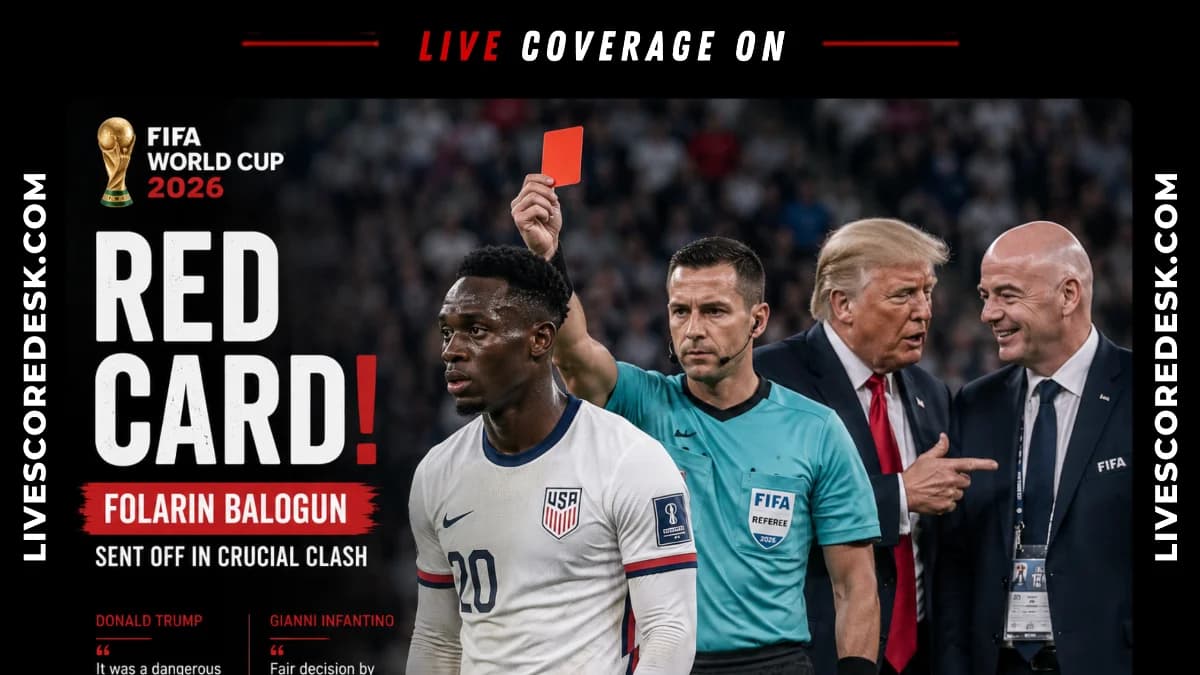
Only One FIFA Official Approved Balogun Ban U-Turn, Report Says
1 of 18. That's the number now driving the biggest governance controversy of the FIFA World Cup 2026. A report by The Times says only FIFA disciplinary committee chairman Mohammad Al-Kamali approved the decision to suspend Folarin Balogun's automatic one-match ban, allowing the United States striker to play after his red card against Bosnia & Herzegovina.
The revelation adds another layer to a controversy that has already drawn global attention after U.S. President Donald Trump confirmed he contacted FIFA president Gianni Infantino asking for the incident to be reviewed. FIFA has repeatedly insisted that its judicial bodies acted independently despite acknowledging the phone call.
What Led To This Decision?
Balogun was shown a straight red card following a VAR review during the United States' Round of 32 victory over Bosnia & Herzegovina. Under FIFA's disciplinary regulations, a direct red card normally carries an automatic one-match suspension.
Instead, FIFA suspended the sanction for 12 months, making Balogun immediately available for the Round of 16 clash against Belgium. Reuters reported that the decision followed Trump's request for FIFA to review the dismissal, although Infantino maintained that the governing body's judicial process remained autonomous.
According to The Times, the decision did not go before the wider 18-member disciplinary committee. Rather, chairman Mohammad Al-Kamali acted alone, a move that has raised questions because high-profile or precedent-setting cases are often considered by a larger panel.
Comparative Breakdown
"FIFA's judicial bodies are independent."
— Gianni Infantino
UEFA And Football Officials Question The Process
The procedure has attracted criticism across European football.
Reuters reported that UEFA described FIFA's handling of the case as "unprecedented, incomprehensible and unjustifiable", arguing that overturning an automatic World Cup suspension undermined confidence in the disciplinary process.
Belgium also challenged Balogun's eligibility before their knockout meeting with the United States, but FIFA rejected that protest. Infantino subsequently released a statement confirming he had spoken with Trump while stressing that conversations with heads of state do not influence judicial decisions.
Legal experts quoted by the Financial Times also questioned whether the committee possessed authority to suspend an automatic sanction in the manner applied in Balogun's case.
Key Facts
What Happens Next?
Although the United States has since exited the tournament, scrutiny over FIFA's governance has intensified rather than faded. Questions now extend beyond Balogun's eligibility to whether existing disciplinary procedures are sufficiently transparent for World Cup competition.
FIFA has not publicly released detailed legal reasoning behind the suspension of Balogun's ban, while calls for greater transparency continue from football authorities and observers.
The next figure to watch may not be a scoreline at all. It could be 18—whether FIFA's full disciplinary committee becomes more involved in future World Cup decisions.