
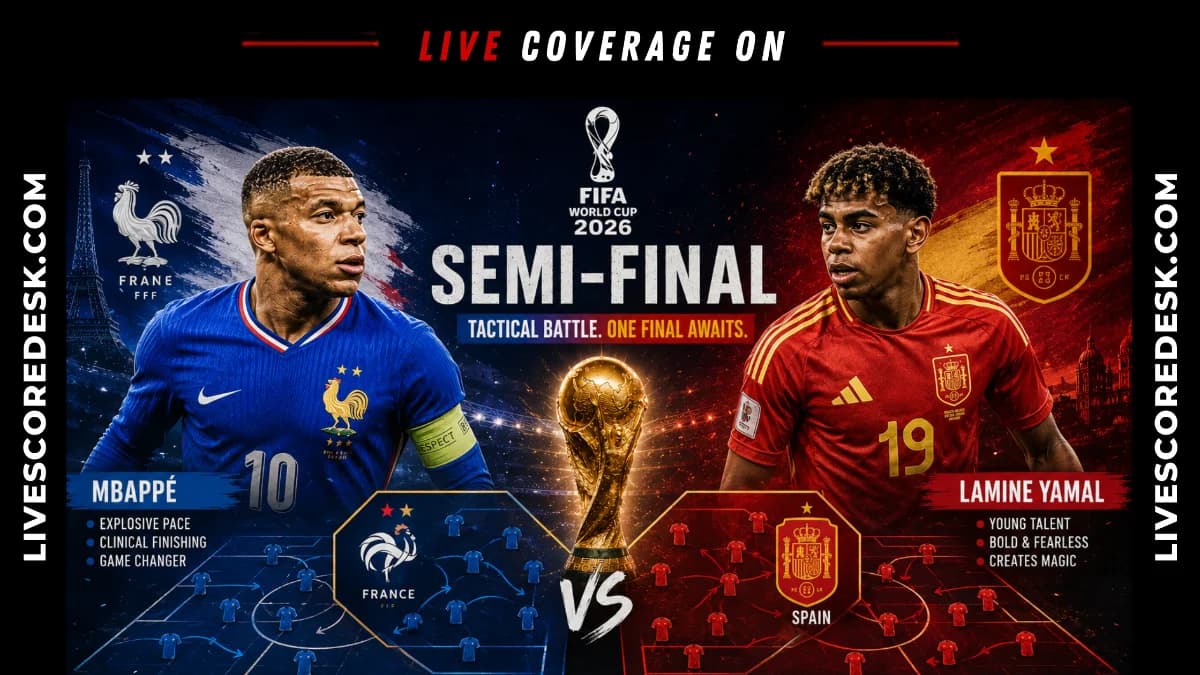
France vs Spain: Why the World Cup's Biggest Tactical Test Isn't Just About Winning
By Kartik Sharma | Data Analyst & Reporter
16 goals. That's how many France have scored on their run to the FIFA World Cup 2026 semi-finals, underlining a transformation few predicted at the start of the tournament. Spain, meanwhile, have built their campaign on control rather than chaos, conceding just once while suffocating opponents with relentless pressing and possession. The meeting between these two European heavyweights isn't simply about reaching a World Cup final. It's a contest between two distinct ideas of how elite football should be played.
France arrive with arguably the most explosive attack left in the competition. Didier Deschamps has gradually shifted away from the cautious style that defined much of his tenure, trusting the pace and creativity of Kylian Mbappé, Ousmane Dembélé, Michael Olise and Désiré Doué to decide matches. Spain, under Luis de la Fuente, remain committed to a possession-first philosophy built on intelligent movement, compact spacing and collective discipline. Different routes. Same destination.
The Midfield Could Decide Everything
Every tactical discussion begins in midfield. Spain's preference for controlling possession allows them to dictate tempo and keep opponents chasing the ball for long periods. France, by contrast, are comfortable spending less time in possession if it means creating higher-quality counter-attacking opportunities.
That difference places enormous pressure on Aurélien Tchouaméni and Adrien Rabiot. Their ability to protect the defence while launching quick attacks will determine whether France's dangerous front line receives the ball in space or spends the evening tracking runners.
A numerical comparison highlights the challenge:
"World Cup semi-finals are often decided by midfield control before attacking quality becomes the difference."
France's New Identity Has Changed Expectations
Only two years ago, criticism of France centred on a conservative approach that often limited attacking expression. That perception has changed dramatically during this World Cup.
Mbappé continues to stretch defensive lines with his pace, while Dembélé's confidence in one-on-one situations has added another dimension. Olise and Doué have injected youth and unpredictability, giving France multiple creators instead of relying on one superstar.
The result is a side that attacks with greater freedom than previous Deschamps teams. Rather than building every move through structured possession, France are prepared to attack immediately after regaining the ball. It is a higher-risk approach, but one that has produced goals consistently throughout the tournament.
This attacking evolution also reflects the depth of France's talent pool. Successive generations have supplied technically gifted forwards capable of thriving in open spaces, allowing the coaching staff to embrace a more direct style without sacrificing quality.
Spain Continue to Trust Collective Structure
Spain's philosophy remains rooted in controlling matches through the ball. Their pressing begins high up the pitch, aiming to recover possession quickly before opponents can launch counter-attacks.
Lamine Yamal provides flair on the wing, but even his creativity operates within a disciplined framework. Midfielders rotate constantly, full-backs support possession, and every player contributes to maintaining compact distances between teammates.
That collective organisation has helped Spain produce one of the tournament's strongest defensive records. Rather than defending deep for extended periods, they often prevent danger by limiting the number of meaningful attacks opponents can create.
It is a demanding style that requires exceptional concentration and physical intensity. When executed well, however, it leaves very little space for rivals to exploit.
Individual Quality Against Collective Precision
The defining contrast is not attack versus defence. It is freedom versus structure.
France are willing to allow gifted attackers greater autonomy, trusting their instincts in transition. Spain rely on carefully rehearsed patterns that minimise unnecessary risk while maximising control of the ball.
Neither philosophy guarantees success. Spain's system depends on technical accuracy over ninety minutes, while France require moments of brilliance from players capable of turning half-chances into decisive goals.
History offers examples supporting both approaches. International tournaments have been won through patient possession and through devastating counter-attacking football. Sunday's semi-final may provide another chapter in that debate.
Numbers That Matter
More Than a Place in the Fina
A place in the FIFA World Cup final is the obvious reward, but the significance extends beyond one result.
Coaches across Europe constantly search for tactical trends that can shape the next generation of teams. If France's direct, transition-heavy football prevails, more national sides may prioritise speed and individual creativity. If Spain dominate through possession once again, the argument for structured positional football grows even stronger.
That makes this semi-final one of the tournament's most fascinating contests. It isn't simply a meeting between two outstanding squads; it is a test of competing football philosophies at the highest level.
When the final whistle blows, the scoreboard will decide who advances. Yet another number may prove just as important: which tactical idea emerges as the blueprint for football's next era?