
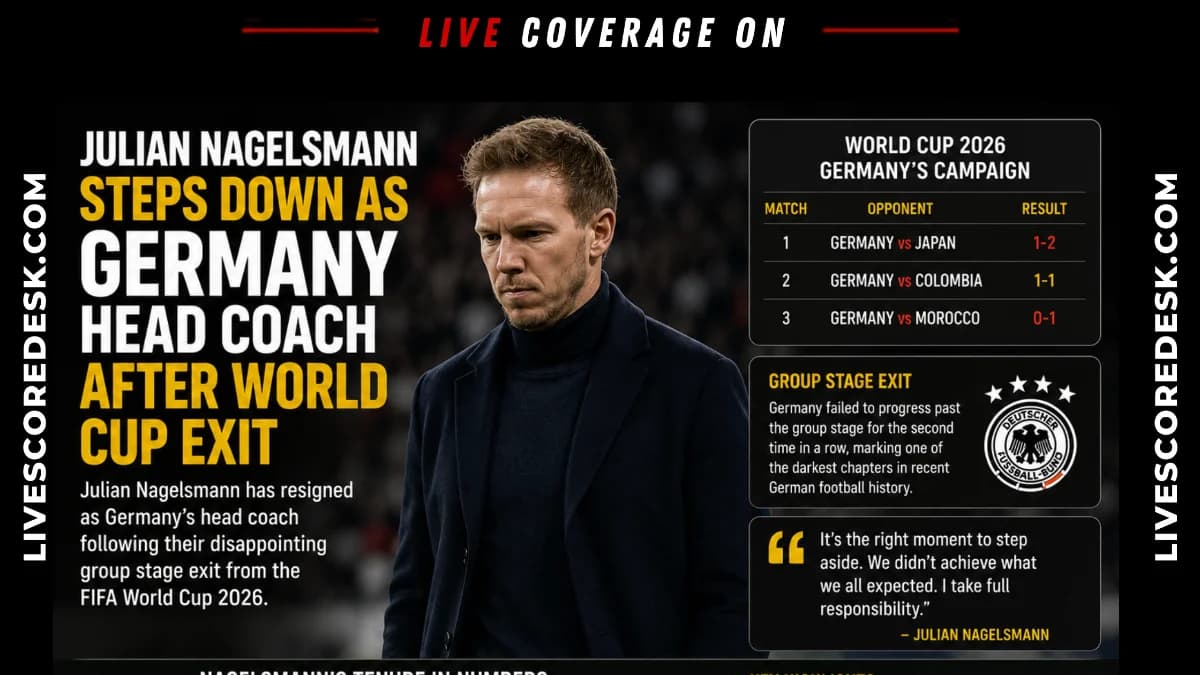
3 tournaments without a deep World Cup run have ended Julian Nagelsmann's Germany reign.
Julian Nagelsmann has stepped down as Germany head coach, bringing an end to his tenure less than three years after taking charge of the four-time world champions. The German Football Association (DFB) confirmed the decision on Friday, days after Germany's shock Round of 32 elimination against Paraguay at the 2026 FIFA World Cup.
The decision follows a crisis meeting at the DFB headquarters in Frankfurt, where Nagelsmann met with president Bernd Neuendorf, sporting director Rudi Völler and other senior officials to review Germany's disappointing campaign. Although the 38-year-old insisted immediately after the defeat that he had no intention of resigning, both sides ultimately agreed that a fresh start was needed.
What Led To Nagelsmann's Departure
Germany's World Cup campaign unravelled far earlier than expected.
The four-time champions were eliminated by Paraguay after a penalty shootout in the Round of 32, extending a worrying trend in major tournaments. Since lifting the World Cup in 2014, Germany have now failed to reach the latter stages in three consecutive editions of the competition. The latest exit intensified scrutiny on a national team already under pressure to rediscover its identity.
Nagelsmann had been appointed in September 2023 with the task of rebuilding the national side after a turbulent period. He guided Germany to the semi-finals of UEFA Euro 2024 and earned praise for restoring attacking intent, but the World Cup remained the benchmark. Falling at the first knockout hurdle fundamentally changed the conversation around his future.
Rather than dismissing the coach outright, the DFB held lengthy discussions before accepting his request to leave. The federation subsequently announced that it would begin talks with former Liverpool and Borussia Dortmund manager Jürgen Klopp regarding the vacant position.
"My top priority has always been the success of the team. After such a bitter disappointment, the team deserves the chance for a fresh start without any baggage,"
Nagelsmann said in the DFB's official statement.
Here's the number that reframes the story: 1,000-plus days after taking charge, Nagelsmann leaves with his contract originally scheduled to run until UEFA Euro 2028. Instead, the World Cup exit has accelerated Germany's latest managerial reset.
Unlike previous coaching changes, this wasn't driven by a long qualifying campaign or a poor Nations League run. One tournament changed everything.
DFB Pays Tribute As Search Begins
"Julian Nagelsmann took over the national team in a difficult sporting situation and gave it fresh momentum. We respect his decision and thank him for his work and commitment."
DFB president Bernd Neuendorf praised the outgoing coach's commitment in the federation's official statement.
Sporting director Rudi Völler, who played a key role in appointing Nagelsmann in 2023, echoed that sentiment. He admitted the World Cup elimination was deeply disappointing but insisted the coach had helped rebuild belief within the squad after several difficult years.
That support, however, couldn't outweigh the numbers.
Germany have now exited the last three FIFA World Cups before reaching the quarter-finals, a stark contrast to the nation's consistency between 2002 and 2014. In tournament football, historical expectations matter, and another early exit proved decisive.
Germany's Recent Tournament Record
Rather than relying on opinions, the numbers explain why pressure mounted so quickly:
- 1. 2014 FIFA World Cup – Champions.
- 2. 2018 FIFA World Cup – Eliminated in the group stage.
- 3. 2022 FIFA World Cup – Eliminated in the group stage.
- 4. 2026 FIFA World Cup – Eliminated in the Round of 32 by Paraguay.
This marks Germany's weakest four-World Cup sequence since the competition expanded to 32 teams.
Nagelsmann also becomes the latest high-profile Germany coach to leave before completing a full World Cup cycle. His departure continues a period of managerial instability that has followed Joachim Löw's highly successful era.
What Happens Next
Germany's immediate priority is appointing a successor before preparations begin for the next international window. The DFB has confirmed that it intends to hold talks with Jürgen Klopp, who has long been regarded as one of the country's preferred candidates after his success with Borussia Dortmund and Liverpool.
Whether Klopp accepts remains the biggest question. The former Liverpool manager has repeatedly spoken about taking a break from frontline coaching, although leading the German national team has often been viewed as one of the few jobs capable of changing that stance.
For Germany's players, another managerial transition means another tactical reset. A new coach will inherit a squad filled with young talent but carrying the weight of repeated tournament disappointments. Restoring consistency will be just as important as improving results.
The next chapter won't be judged by promises. It will be judged by numbers.
Germany's next competitive campaign begins under new leadership, and one statistic will define whether this decision was the right one: how far can the four-time world champions go at their next major tournament?