
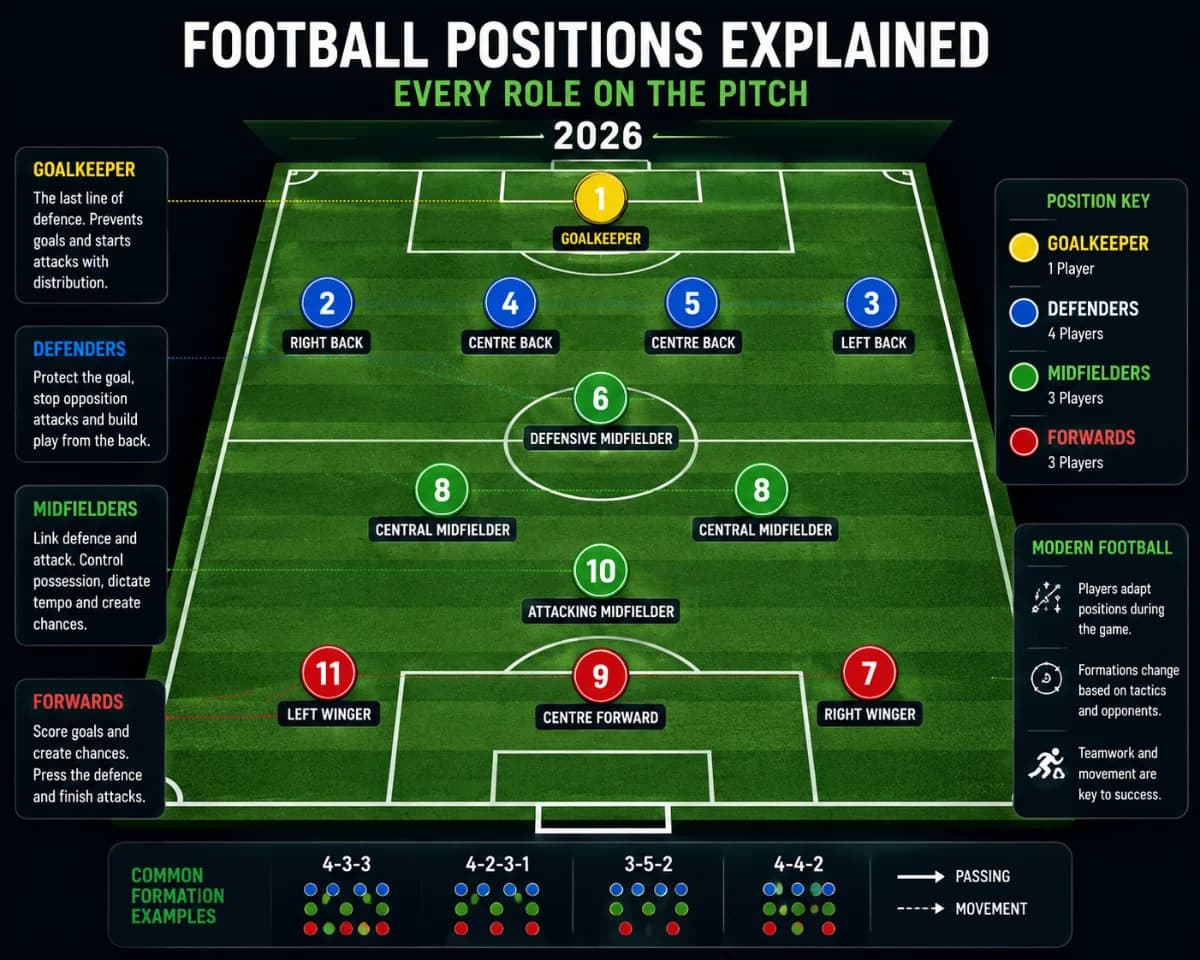
Understanding football positions is the quickest way to understand the game itself.
Football positions explained isn't just about memorising where players stand on the pitch. It's about understanding how every role contributes to attack, defence and the transitions in between. Whether you're watching the Premier League, the Champions League or a local Sunday match, recognising each position helps make sense of tactics, substitutions and why certain players are so valuable.
Modern football has evolved dramatically from the rigid formations of decades past. While traditional positions still exist, today's players are expected to adapt constantly, with full-backs becoming playmakers, midfielders dropping into defence and forwards pressing high up the pitch. The fundamentals, though, remain the same. Every position has a distinct purpose that helps a team function as a unit.
The Goalkeeper: Football's Last Line of Defence
The goalkeeper is the only player allowed to handle the ball inside their own penalty area. Their primary job is simple: prevent goals. But modern goalkeepers are expected to do much more than make saves.
Elite keepers now act as the first point of attack, distributing the ball accurately with both hands and feet. The rise of the "sweeper-keeper" has seen goalkeepers move outside their penalty area to clear danger and support possession-based football.
Players such as Manuel Neuer popularised this approach, while Alisson Becker and Ederson have shown how distribution can launch counter-attacks within seconds.
Defenders: Building the Foundation
Defenders protect their own goal, but each defensive position carries different responsibilities.
Centre-backs occupy the middle of defence. They win aerial duels, intercept passes, block shots and organise the back line. Physical strength, positioning and communication are essential traits.
Full-backs operate on the left and right sides of defence. Traditionally, they focused on stopping opposition wingers. Modern football asks much more. Today's full-backs regularly overlap into attacking areas, deliver crosses and even contribute goals and assists.
A growing tactical trend is the inverted full-back, who moves into central midfield during possession to help control the game rather than staying wide.
Midfielders: The Engine Room
Midfield is often described as the heart of football because it links defence and attack.
A defensive midfielder shields the defence, breaks up opposition attacks and recycles possession. These players rarely receive headlines, yet they're often indispensable.
A central midfielder balances defensive duties with creative responsibilities. They're expected to retain possession, dictate tempo and support both penalty areas.
Then comes the attacking midfielder, sometimes known as the No.10. Positioned behind the striker, this player creates scoring opportunities through vision, passing and movement between defensive lines.
Here's where many casual fans get confused. Shirt numbers don't always match positions anymore. A player wearing number eight may play deep, while a number ten could operate from the wing. Modern tactics have blurred those traditional distinctions.
Wide Players Have Changed the Modern Game
Wingers once hugged the touchline and crossed the ball into the penalty area. Not anymore.
Today's wide forwards frequently cut inside onto their stronger foot, allowing full-backs to provide width from overlapping runs. This tactical evolution has produced some of football's most dangerous attackers.
An inside forward starts wide before driving towards goal, while a traditional winger remains closer to the touchline and focuses on stretching the opposition defence.
The role depends heavily on the team's tactical philosophy. Possession-oriented teams often prefer inverted wingers, while counter-attacking sides may value pace and direct running.
Strikers and Centre-Forwards: More Than Just Goals
Scoring remains the striker's primary responsibility, but modern centre-forwards contribute far beyond finishing chances.
A traditional target man uses strength to hold up play, win aerial battles and bring teammates into attacks.
A poacher thrives inside the penalty area, relying on positioning and instinct rather than build-up play.
Then there's the increasingly popular false nine. Instead of remaining near the opposition goal, this player drops into midfield, dragging defenders out of position and creating space for teammates to exploit.
The success of the false nine has influenced clubs worldwide, proving that movement can be just as dangerous as physical presence.
Quick Reference: Common Football Positions
| Position | Primary Role | Typical Shirt Number |
|---|---|---|
| Goalkeeper | Prevent goals, organise defence | 1 |
| Centre-back | Central defender | 4, 5 |
| Full-back | Wide defender | 2, 3 |
| Defensive Midfielder | Protect defence | 6 |
| Central Midfielder | Link defence and attack | 8 |
| Attacking Midfielder | Create chances | 10 |
| Winger | Attack from wide areas | 7, 11 |
| Striker | Score goals | 9 |
Why Formations Matter as Much as Positions
A player's role changes depending on formation. A full-back in a 4-4-2 performs different tasks from a wing-back in a 3-5-2. Likewise, a lone striker in a 4-3-3 must often hold the ball longer than one playing alongside a strike partner.
Managers adapt systems based on opponents, player strengths and match situations. That's why understanding positions alone isn't enough. Recognising how those positions interact within different formations provides a much clearer picture of modern football tactics.
For new fans, learning the core responsibilities of each position is the best starting point. Once those fundamentals become familiar, tactical systems, pressing strategies and player movements become far easier to follow. Football may look simple at first glance, but every position carries its own specialist role—and together, they form the tactical puzzle that makes the world's most popular sport endlessly fascinating.