
12 players may appear on a team sheet, but only 11 can take the field. That's just one of cricket's many rules that confuse first-time fans.
Cricket Rules Explained starts with one simple idea: two teams compete to score more runs than each other, but they do it by combining batting, bowling and fielding in ways unlike any other major sport. Once you understand wickets, overs and runs, the game becomes surprisingly easy to follow.
Cricket has been played for centuries, yet millions of new fans discover it every year through tournaments like the ICC Cricket World Cup, T20 World Cup and the Indian Premier League (IPL). The sport can look complicated because of its unique terminology, but the core objective never changes. One team bats and tries to score runs. The other bowls and fields, attempting to dismiss batters and limit scoring. After both sides have completed their innings—depending on the match format—the team with more runs wins.
Whether you're watching your first Test match, an IPL thriller or a World Cup final, these fundamental rules apply everywhere.
Understanding Runs, Wickets and Overs
The easiest way to understand cricket is to break every match into three basic elements: runs, wickets and overs.
Runs: How Teams Score
A run is the basic unit of scoring.
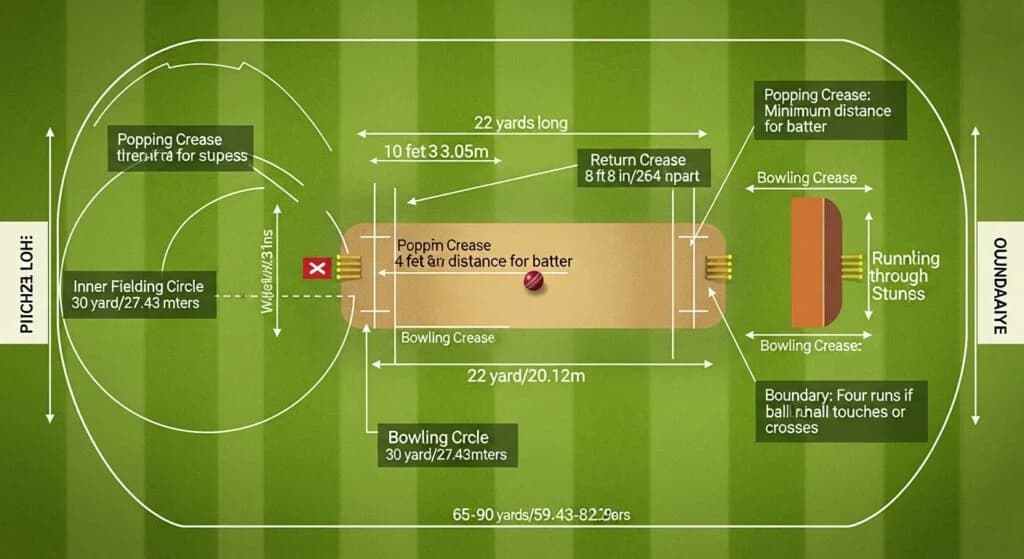
The most common way to score is simple. After the batter hits the ball, both batters run to the opposite ends of the pitch before the fielding team can return the ball. Each successful exchange equals one run.
Teams can also score boundaries:
- 1. 4 runs if the ball reaches the boundary after bouncing.
- 2. 6 runs if the ball clears the boundary without touching the ground.
There are also extras, awarded without the batter necessarily hitting the ball. These include wides, no-balls, byes and leg byes under the Laws of Cricket and ICC playing conditions.
Wickets: How Batters Are Dismissed
The fielding team's objective is to take 10 wickets in an innings.
A wicket falls when a batter is dismissed. There are ten recognised methods of dismissal in the Laws of Cricket, but beginners only need to know the most common ones:
- Bowled – the ball hits the stumps.
- Caught – a fielder catches the ball before it bounces.
- LBW (Leg Before Wicket) – the batter's body illegally blocks a ball that would have hit the stumps.
- Run Out – the fielding team breaks the stumps before the batter safely reaches the crease.
- Stumped – the wicketkeeper removes the bails while the batter is outside the crease and not attempting a run.
Once 10 batters are out, the innings ends because only one batter remains.
"A cricket team has 11 players, but an innings ends after 10 wickets because two batters are required to continue batting."
Overs: Why Bowlers Can't Keep Bowling Forever
An over consists of six legal deliveries bowled by one bowler.
After every over, a different bowler operates from the opposite end of the pitch. A single bowler cannot bowl consecutive overs from the same end, ensuring variety and preventing one player from dominating an innings.
The number of overs depends on the match format:
| Format | Overs Per Side |
|---|---|
| T20 | 20 |
| One-Day International (ODI) | 50 |
| Test Cricket | No over limit |
This difference explains why T20 cricket is finished in around three hours, while Test cricket can last up to five days.
Many new viewers assume every cricket match follows the same rules. It doesn't. The scoring system remains largely identical, but the number of overs dramatically changes tactics, batting approach and bowling strategies.
Innings, Match Formats and Winning the Game
Once you understand runs, wickets and overs, the next step is learning how different cricket formats are structured.
An innings is a team's turn to bat.
In limited-overs cricket, each team bats once. In Test cricket, each team usually bats twice, making strategy very different from white-ball formats.
Here's how the three major formats compare:
| Format | Innings per Team | Overs | Typical Duration |
|---|---|---|---|
| T20 | 1 | 20 | About 3 hours |
| ODI | 1 | 50 | About 7–8 hours |
| Test | 2 | Unlimited | Up to 5 days |
Understanding Extras and Common Umpire Signals
Not every run comes from the bat.
The umpire can award extras, which count towards the team's total but are recorded separately from a batter's score.
The four main types are:
- Wide – The ball is too far from the batter to be played fairly.
- No-ball – The bowler commits an illegal delivery, such as overstepping the popping crease.
- Bye – The batter misses the ball and runs are completed without the ball touching the bat or body.
- Leg bye – The ball strikes the batter's body (not the hand holding the bat) and runs are taken legally.
Beginners should also recognise a few common umpire signals:
- One arm stretched sideways = Wide.
- One arm extended horizontally = No-ball.
- Raised index finger = Batter out.
- Both arms raised above the head = Six.
- One arm waved across the chest = Four.
Learning these signals makes following a live match much easier, even with the sound off.
Quick Cricket Rules Reference
| Rule | Simple Explanation |
|---|---|
| Players per team | 11 |
| Maximum wickets in an innings | 10 |
| Legal balls in an over | 6 |
| Runs for a boundary | 4 |
| Runs for clearing the boundary | 6 |
| Most common dismissal | Bowled, Caught, LBW, Run Out, Stumped |
| Winner | Team with more runs (subject to match conditions) |
Questions Every New Cricket Fan Asks
Why doesn't every batter get to bat?
Because an innings can end before all 11 players have batted. If the team reaches its target while chasing, the match finishes immediately. Likewise, if 10 wickets fall, the innings is over even if one player hasn't had a chance to face a ball.
Another common question is why bowlers stop after a few overs in shorter formats.
The answer is balance. In T20 Internationals and ODIs, one bowler may bowl only a limited share of the innings (normally four overs in T20s and ten in ODIs). This prevents a single elite bowler from dominating the entire match and encourages teams to develop multiple bowling options.
Cricket can seem filled with unusual vocabulary at first, but every match still revolves around the same contest: score more runs than the opposition before running out of overs or wickets. Once those fundamentals click, field placements, bowling tactics and batting strategies become far easier to appreciate.
The next time you watch a match, don't try to learn every law at once. Focus on the scoreboard. Count the overs. Watch how wickets change momentum. Before long, the numbers that once looked confusing will begin telling the story of the game themselves.