
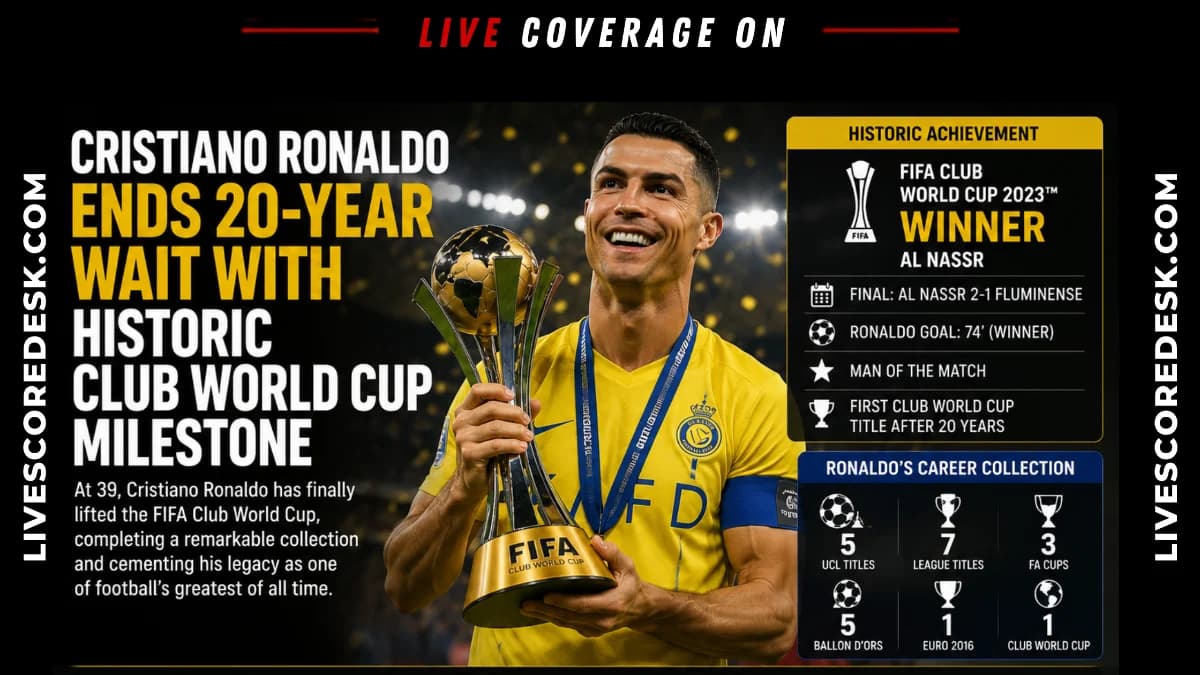
Cristiano Ronaldo's greatest gift isn't longevity anymore — it's still deciding the biggest moments.
Cristiano Ronaldo's first FIFA Club World Cup knockout-stage goal took 20 years to arrive. That sounds almost impossible for a player who has spent two decades rewriting football's scoring records. Yet when Al Nassr defeated Manchester City in the Round of 16 of the expanded FIFA Club World Cup, Ronaldo finally ticked off one of the few remaining boxes in his extraordinary career.
The goal itself matters. The timing matters even more. At 41, with critics questioning whether he can still influence elite-level knockout football, Ronaldo delivered when the stakes were highest. Here's the part nobody's saying out loud: this wasn't about adding another statistic to an already ridiculous collection. It was about proving that football's greatest goalscorers don't simply survive the passing of time—they continue to shape it.
Twenty Years To Complete One Missing Chapter
Ronaldo has scored in almost every competition imaginable. UEFA Champions League finals, European Championship matches, FIFA World Cups, domestic league title races and countless cup competitions have all featured his trademark celebrations.
But the FIFA Club World Cup knockout stages remained a curious omission.
The reason wasn't a lack of quality. For much of the tournament's previous format, European champions entered directly at the semi-final stage. Ronaldo's former clubs often progressed efficiently, while some of his appearances came in finals where opportunities were limited. The expanded 32-team tournament has changed that landscape, creating a proper knockout journey similar to the FIFA World Cup.
Against Manchester City, Ronaldo finally seized the opportunity.
His finish wasn't a spectacular bicycle kick or a 30-yard thunderbolt. It didn't need to be. Great goalscorers have always understood that timing outweighs aesthetics. Finding space inside the penalty area, Ronaldo converted with the composure that has defined his career across Sporting CP, Manchester United, Real Madrid, Juventus and now Al Nassr.
"Cristiano Ronaldo waited two decades to score his first FIFA Club World Cup knockout-stage goal. Once the chance arrived, he needed only one finish."
The Numbers Still Refuse To Slow Down
The obvious counter-argument is age.
Ronaldo turned 41 earlier this year. Most footballers have long retired by that stage, while even the greatest modern forwards usually transition into reduced roles before hanging up their boots. Physical decline is unavoidable.
Or so conventional wisdom says.
Instead, Ronaldo continues producing goals at a remarkable rate for club and country. His movement inside the box remains elite, while his positional awareness often compensates for any reduction in explosive pace. Those qualities were evident again against Manchester City.
Supporters who dismiss his performances because they come outside Europe's traditional top five leagues often overlook a simple truth: finishing under pressure never becomes easy. Knockout football magnifies every mistake, every missed chance and every moment of hesitation.
Ronaldo didn't hesitate.
That doesn't mean every criticism aimed at him is unfair. His pressing intensity isn't what it once was, and teams must adapt tactically around his strengths. Those are legitimate discussions. But judging a striker ultimately comes down to one question: does he still decide matches?
Against one of Europe's strongest squads, the answer was unmistakable.
Football has always rewarded players who deliver when elimination is on the line. Ronaldo has built an entire career on those moments, from Manchester United to Real Madrid, Portugal and beyond. This latest milestone doesn't redefine his legacy—it reinforces the very quality that made it historic in the first place.
Official Backing Doesn't End The Debate
Ronaldo's supporters will point to another familiar argument: numbers don't lie.
His critics, meanwhile, argue that football has evolved beyond building attacks around a single veteran forward. They question whether his overall contribution matches that of younger, more mobile strikers capable of pressing aggressively for 90 minutes.
It's a fair debate. Modern football demands far more than goals alone.
Yet knockout competitions have a habit of exposing the limits of purely tactical arguments. Coaches spend hours preparing pressing structures, passing patterns and defensive triggers. One clinical finish can undo all of it.
That's exactly why Ronaldo's longevity deserves more credit than it often receives. Maintaining elite fitness for two decades is remarkable. Remaining decisive in high-pressure matches after two decades is something even fewer players have managed.
Former coaches and teammates have repeatedly highlighted the obsession that fuels that consistency. From strict recovery routines to relentless training standards, Ronaldo has treated his body as professionally as any athlete in modern sport. The reward isn't merely extending a career—it's extending relevance.
The expanded FIFA Club World Cup has also presented experienced players with a fresh stage. Unlike the previous seven-team format, the new competition demands navigating multiple knockout rounds against stronger opposition. Ronaldo's breakthrough goal therefore carries more competitive weight than the statistic alone suggests.
Ronaldo's Legacy Keeps Finding New Chapters
Football loves declaring the end of great players.
It happened after Portugal's disappointing campaigns. It happened when Ronaldo left Europe. It happened almost every season he entered his late thirties.
And yet another milestone has arrived.
No, this goal won't rank alongside his bicycle kick against Juventus or his towering header against Manchester United in the UEFA Champions League. It doesn't need to. Those moments defined his brilliance; this one underlines his endurance.
Perhaps that's the more remarkable achievement.
Few players remain relevant across three footballing generations. Ronaldo has now shared pitches with legends who have retired, current superstars in their prime and teenagers just beginning their professional careers. Through every tactical revolution, managerial change and physical challenge, one constant has remained: he continues to score.
What Comes Next For Ronaldo
Al Nassr's progress in the FIFA Club World Cup ensures Ronaldo will have further opportunities to add to a record that already borders on the unimaginable. More importantly, the tournament offers another chance to answer the doubts that inevitably accompany every athlete competing into their forties.
There will be tougher opponents. There will be stronger defences. There will almost certainly be fresh debates whenever he fails to score.
That's football.
But here's where the evidence outweighs the noise. Time and again, Ronaldo has responded to scepticism not through interviews or social media posts, but through decisive moments on the pitch. His latest goal doesn't erase every criticism of his game, nor should it. What it does prove is that writing off one of football's greatest competitors has remained a losing bet for the better part of two decades.
The verdict is simple: Cristiano Ronaldo no longer needs to prove he belongs among football's immortals. Yet even at 41, he keeps finding new ways to strengthen the argument that no career has combined longevity, consistency and decisive goals quite like his.