
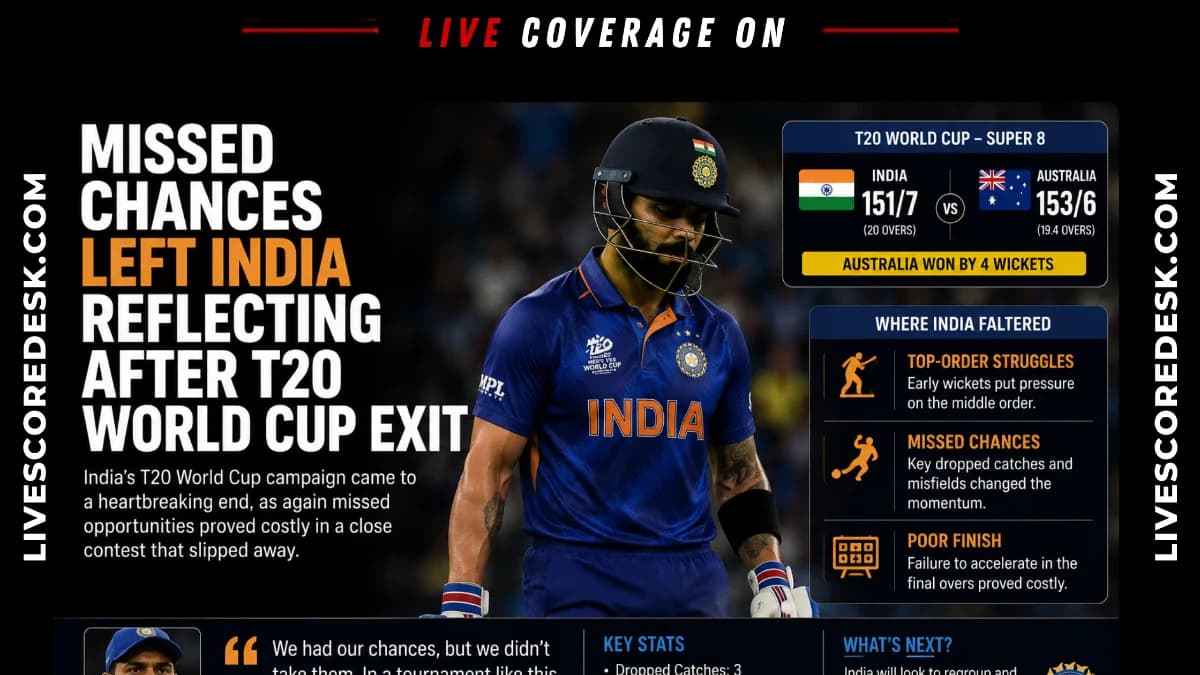
Missed Chances and Unsettled Selection: Why India's Women's T20 World Cup Campaign Became a Tournament of What-Ifs
India's Women's T20 World Cup campaign ended with familiar questions rather than clear answers. The six-wicket defeat to Australia at Lord's sealed their elimination, but the discussion extends well beyond one result. Across the tournament, India produced periods of high-quality cricket, yet recurring lapses in selection, fielding and game management repeatedly undermined their progress.
The decisive moment came on the final day of Group A. India needed to beat Australia after South Africa had already secured victory over Bangladesh earlier in the day. Harmanpreet Kaur's side posted 170, their highest Women's T20 World Cup total against Australia, but Ellyse Perry and Ashleigh Gardner added a match-winning century partnership as Australia completed the chase in 19 overs to qualify alongside South Africa. That defeat became the trigger for a wider debate over India's campaign rather than simply their final performance.
Why India's Women's T20 World Cup Campaign Became a Story of Uncertainty
One argument centres on consistency. India rarely fielded the same combination for consecutive matches, using every member of their 16-player squad during the tournament according to ESPNcricinfo's analysis. Injuries, including the loss of Shreyanka Patil, forced some changes, but tactical alterations continued throughout the competition, making it difficult to establish settled roles.
Fielding also proved costly. Earlier in the tournament, dropped chances against South Africa allowed Marizanne Kapp to capitalise and guide her side to a successful chase. Harmanpreet Kaur acknowledged afterwards that missed opportunities in the field had made the difference. Against Australia, India again let key moments slip as Perry and Gardner gradually took control of the chase.
Batting presented another contrast. India regularly built competitive platforms but were unable to maximise them consistently. Their total of 170 against Australia reflected strong contributions from Harmanpreet Kaur and Jemimah Rodrigues, yet Australia's experienced middle order demonstrated the difference in converting pressure into victory during the chase.
"India racked up their highest total against Australia in a Women's T20 World Cup match, but it still wasn't enough."
The Other Side: Injuries and Strong Individual Performances Tell a Different Story
The campaign cannot be viewed solely through its shortcomings. India entered the tournament after winning the ODI World Cup earlier in the year and opened impressively with victories including a commanding win over Pakistan. Young left-arm spinner Shree Charani emerged as one of the competition's standout bowlers, becoming India's most successful wicket-taker in a single Women's T20 World Cup edition.
Injuries also disrupted planning. Shreyanka Patil's tournament-ending ankle injury forced the team management into an unplanned replacement, while conditions in England demanded continual adjustments. Those factors explain some of the selection changes, although critics argue that tactical uncertainty extended beyond injury-enforced decisions. livescoredesk highlighted that India never appeared to settle on a preferred XI, while others point out that adapting to different venues is a normal requirement in global tournaments.
Historically, India have experienced similar disappointments in ICC knockout races despite possessing world-class individual players. The pattern stretches back through several global events in which strong league performances have not translated into titles. This tournament followed a comparable path: moments of promise interrupted by decisive mistakes against elite opposition.
What Comes Next for India's Women's T20 World Cup Campaign
India's immediate focus shifts away from the tournament while Australia progress to the semi-finals against West Indies and South Africa prepare to face England. Attention is also likely to move towards assessing squad balance, leadership and whether a more settled approach is adopted ahead of future ICC events.
The tournament offered evidence that India remain capable of competing with the strongest sides. It also reinforced how narrow the margins are in T20 cricket. Whether the campaign is ultimately remembered for missed chances or as a necessary stage in the team's evolution will depend on how those lessons shape the next ICC tournament.