
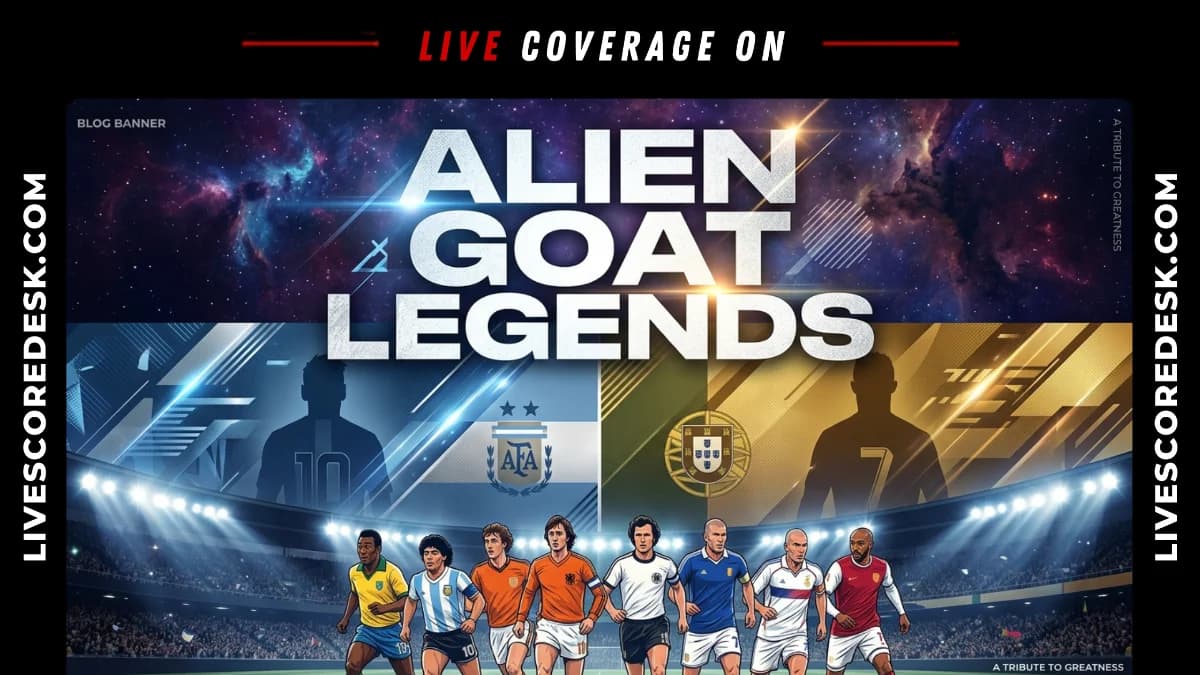
Greatest Soccer Player of All Time: Analysis & Debate
By Kartik Sharma
Data Analyst & Reporter (KS)
More than 2,000 international goals, 13 Ballon d'Or awards and nine FIFA World Cup titles are shared among the five names that dominate the greatest soccer player of all time debate. Those numbers explain why there still isn't universal agreement. Every generation has watched a different player redefine football, making comparisons across eras both fascinating and difficult.
The greatest soccer player of all time isn't decided by one statistic. Goals matter, but so do trophies, longevity, influence, individual awards and performances on football's biggest stages. Pelé inspired Brazil's first global dominance. Diego Maradona almost single-handedly carried Argentina to World Cup glory. Lionel Messi combined extraordinary consistency with sustained excellence over two decades. Cristiano Ronaldo rewrote goalscoring records across multiple leagues. Johan Cruyff transformed the way football is played, even beyond his playing career.
What Defines the Greatest Soccer Player of All Time?
There is no official governing body that crowns football's greatest player. FIFA, UEFA and national federations celebrate achievements, but the debate relies on measurable success alongside cultural impact.
Several factors consistently appear in discussions among analysts, historians and former professionals:
Numbers provide the foundation. Context finishes the argument.
Lionel Messi's Case: Complete Football Across Two Decades
Few players have combined creativity and goalscoring as consistently as Lionel Messi.
After making his Barcelona debut in 2004, Messi evolved into football's most complete attacking player. He became equally effective as a goalscorer, playmaker and ball carrier. Unlike traditional forwards, he regularly dropped into midfield, dictated possession and still finished among Europe's leading scorers.
His career includes numerous La Liga titles, UEFA Champions League triumphs, Copa América success with Argentina and, crucially, victory at the 2022 FIFA World Cup. That tournament removed the one major omission critics had long highlighted.
Messi also holds multiple Ballon d'Or awards, reflecting sustained excellence recognised by journalists worldwide.
"Winning the World Cup was what I was missing."
— Lionel Messi after Argentina's 2022 FIFA World Cup triumph.
Pelé's Legacy: The Benchmark for World Cup Greatness
Long before advanced metrics existed, Pelé established standards that players still chase today.
The Brazilian icon remains the only player to win three FIFA World Cups (1958, 1962 and 1970). Although injuries limited his involvement during parts of the 1962 tournament, he was still officially part of Brazil's victorious squad.
His influence extended far beyond statistics. Pelé transformed football into a truly global sport during television's rapid international expansion, helping popularise the game across continents.
Several of his official records remain subjects of debate because friendly matches counted differently during his era. However, FIFA recognises his extraordinary scoring output, while historians continue to regard him as one of football's defining figures.
His playing style also arrived decades ahead of its time. Quick combinations, athletic movement and technical precision became trademarks of Brazilian football partly because of Pelé's influence.
Diego Maradona's Greatest Argument: One Tournament Changed Everything
If one competition carries extraordinary weight in this debate, it is the 1986 FIFA World Cup.
Maradona captained Argentina to the title while producing one of the finest individual tournament performances football has witnessed. His quarter-final against England delivered two of the sport's most discussed moments: the controversial "Hand of God" goal and the remarkable solo effort later voted FIFA's Goal of the Century.
Unlike players surrounded by multiple Ballon d'Or winners, Maradona often carried teams through individual brilliance. His spell at Napoli remains particularly significant.
A comparative look highlights his impact:
Cristiano Ronaldo's Argument: Unmatched Longevity and Goalscoring
If the debate is built around consistency and goals, Cristiano Ronaldo demands equal consideration.
The Portuguese forward has maintained elite performance across Sporting CP, Manchester United, Real Madrid, Juventus, Al Nassr and Portugal, adapting his game as football evolved. Early in his career he relied on explosive pace and dribbling. Later, he became one of the game's most clinical penalty-box finishers.
Ronaldo also became the first player to finish as the UEFA Champions League's all-time leading scorer while winning the competition with multiple squads. His international record has been equally remarkable, with Portugal claiming UEFA Euro 2016 and the 2019 UEFA Nations League during his career.
His case rests on several measurable achievements:
Johan Cruyff Changed Football Beyond the Pitch
Some legends are remembered as much for their ideas as their statistics.
Johan Cruyff's numbers were outstanding, but his greatest contribution came through his influence on modern football. As the symbol of Ajax and the Netherlands' "Total Football" philosophy during the 1970s, Cruyff demonstrated how intelligence, movement and positional flexibility could dominate opponents.
Later, as Barcelona manager, he laid the foundations for a playing philosophy that eventually shaped generations of stars, including Xavi, Andrés Iniesta and Lionel Messi.
His legacy is difficult to measure through goals alone. Tactical innovation doesn't appear on a scoresheet, yet it changes football for decades.
Quick Reference: Comparing the GOAT Candidates
| Player | Strongest Case | Signature Achievement |
|---|---|---|
| Lionel Messi | Complete attacking player | FIFA World Cup 2022, record Ballon d'Or wins |
| Pelé | International success | Three FIFA World Cup titles |
| Diego Maradona | Individual tournament impact | Argentina's 1986 World Cup triumph |
| Cristiano Ronaldo | Longevity and goals | Longevity and goals |
| Johan Cruyff | Tactical influence | Total Football and Barcelona philosophy |
Why Different Generations Reach Different Conclusions
The greatest soccer player of all time debate often reflects the era people grew up watching.
Supporters of Pelé point to three World Cups achieved when international football was the sport's highest stage. Maradona fans value carrying relatively modest teams to extraordinary success. Younger audiences have witnessed Messi and Ronaldo compete at an elite level for nearly two decades while breaking records almost every season.
There's also the challenge of comparing vastly different eras. Sports science, nutrition, pitches, travel and defensive tactics have changed dramatically since the 1960s. Modern players face longer club seasons and greater physical demands, while earlier legends played in harsher conditions with fewer protections from referees.
Because of those differences, direct statistical comparisons can only tell part of the story.
The debate has also evolved with advanced analytics. Metrics such as expected goals (xG), expected assists (xA), progressive carries and chance creation now provide deeper insight into attacking performance than goals alone. Unsurprisingly, Messi frequently ranks among the leaders in both scoring and creative categories, while Ronaldo's finishing efficiency remains among the best ever recorded.
Ultimately, football's greatest player depends on how greatness is defined. If World Cups carry the greatest weight, Pelé's case remains exceptional. If complete attacking football is the benchmark, Messi has a compelling argument. If longevity and relentless production matter most, Ronaldo stands alongside anyone in history. If one tournament can define immortality, Maradona's 1986 campaign is difficult to surpass. And if changing football itself counts as greatness, Cruyff belongs in every serious discussion.
No statistic settles the argument completely. Perhaps that's why the debate continues across generations—and why it probably always will.
The next era will produce another superstar. The real question is this: what number will that player have to reach before today's legends are finally challenged?