
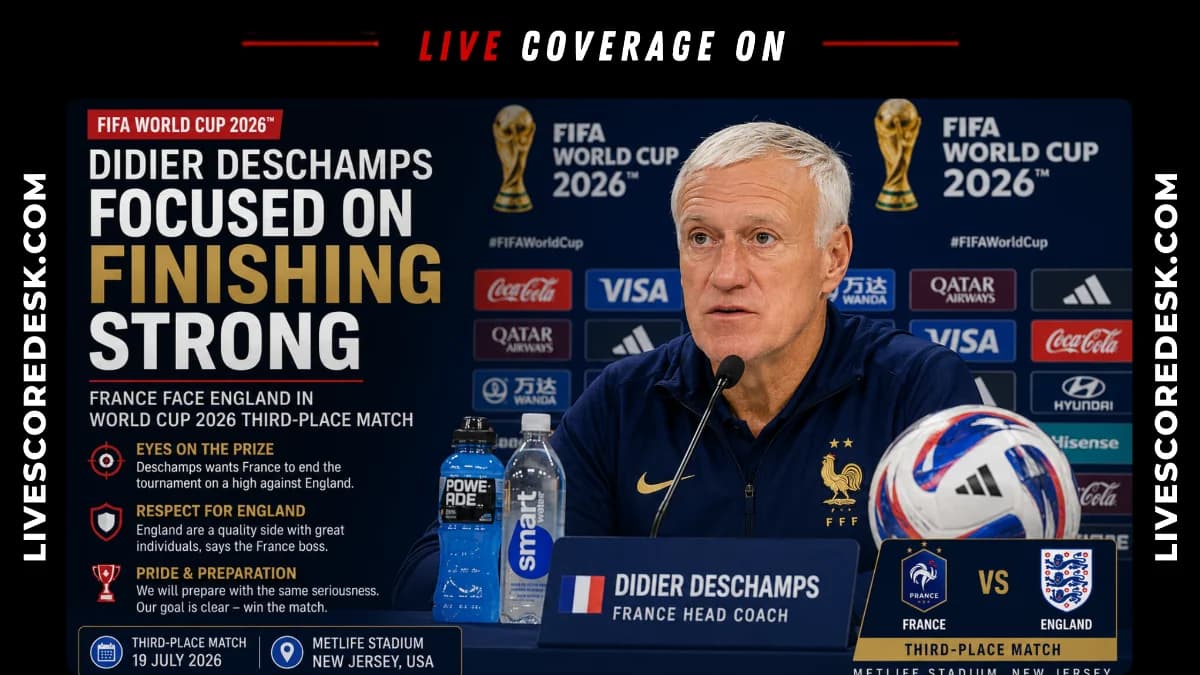
Didier Deschamps Admits France And England 'Don't Want To Play' World Cup Third-Place Match
By Shivam Kumar (SK), Senior Sports Reporter
Didier Deschamps says neither France nor England truly wants to contest the FIFA World Cup 2026 third-place play-off, but both teams will still be expected to finish the tournament professionally. The France manager made the candid admission ahead of Saturday's meeting after both nations suffered semi-final defeats and missed out on the World Cup final.
The match at MetLife Stadium in New Jersey will decide who finishes third at the expanded 48-team FIFA World Cup, although the fixture has often divided opinion among players and coaches. England arrive after losing to Argentina in the semi-finals, while France were beaten by Spain. With the title no longer at stake, Deschamps acknowledged the emotional challenge of preparing players for what is traditionally one of football's least popular fixtures.
France's Path To The FIFA World Cup 2026 Third-Place Match
France entered the tournament among the favourites and once again progressed deep into the knockout rounds, extending a remarkable run under Deschamps that has seen Les Bleus reach the latter stages of every major tournament in recent years.
Their World Cup campaign, however, ended in disappointment against Spain in the semi-finals. Despite boasting one of the tournament's strongest attacking squads, France were unable to overturn Spain's control during key moments of the contest and were eliminated one step short of another World Cup final.
Speaking before facing England, Deschamps admitted the psychological hurdle both teams now face.
"England don't want to play, neither do we. When you're at a World Cup, you're here to become world champions. Neither of us managed that. But since we have to play the match, we'll prepare as well as possible."
The French coach stressed that the disappointment of missing the final cannot be ignored, but added that representing France still carries responsibility regardless of the occasion. He also suggested that players recovering mentally after a semi-final defeat is one of the biggest challenges facing coaching staffs before the third-place fixture.
Deschamps' remarks echo a debate that has surrounded the World Cup bronze-medal match for decades. Several coaches and players have previously questioned whether the fixture serves a competitive purpose, arguing that teams are often still processing the disappointment of falling one match short of the final. FIFA, however, continues to stage the match as part of the tournament schedule, with third place remaining an official finishing position in the competition.
Historically, France have experienced mixed fortunes in World Cup third-place matches. They defeated Belgium to finish third at Mexico 1986 before losing the opportunity to compete in similar fixtures during their title-winning campaigns in 1998 and 2018, when they reached and won the finals instead.
For Deschamps, whose managerial career already includes a FIFA World Cup title in 2018 and another runners-up finish in 2022, the immediate task is ensuring his squad responds professionally despite the emotional setback of semi-final elimination.
England's Path To The FIFA World Cup 2026 Third-Place Match
England also arrived in the United States with genuine ambitions of lifting their first World Cup since 1966, but those hopes ended with a semi-final defeat to defending champions Argentina. Thomas Tuchel's side had impressed through much of the tournament, combining defensive organisation with moments of attacking quality, only to fall short against Lionel Messi and company.
The defeat ensured England would once again contest the World Cup's third-place play-off rather than the final. Like France, the Three Lions now face the challenge of quickly recovering from the disappointment of missing out on football's biggest prize.
Tuchel has consistently maintained that every England match carries significance, even if the players would have preferred to be preparing for Sunday's final. Finishing third would at least provide a positive conclusion to an otherwise impressive tournament and offer momentum ahead of the team's next competitive fixtures.
"England don't want to play, neither do we. But since we have to play the match, we'll prepare as well as possible."
— Didier Deschamps
STATS
What To Watch For
The biggest question isn't tactical—it's psychological. Both managers must judge how quickly their squads have recovered from semi-final disappointment while deciding whether to rotate players or rely on experienced leaders for one final performance.
England's attacking threat will again revolve around captain Harry Kane, while France possess match-winners across the front line capable of changing games even when motivation is difficult to generate. Midfield control, energy levels and concentration could prove more decisive than elaborate tactical plans in a fixture where emotions remain raw.
The third-place play-off may never command the attention of a World Cup final, but it still offers both nations an opportunity to finish the tournament with a victory and a podium place. For England and France, professional pride—and ending the campaign on a winning note—will now be the primary objective.