
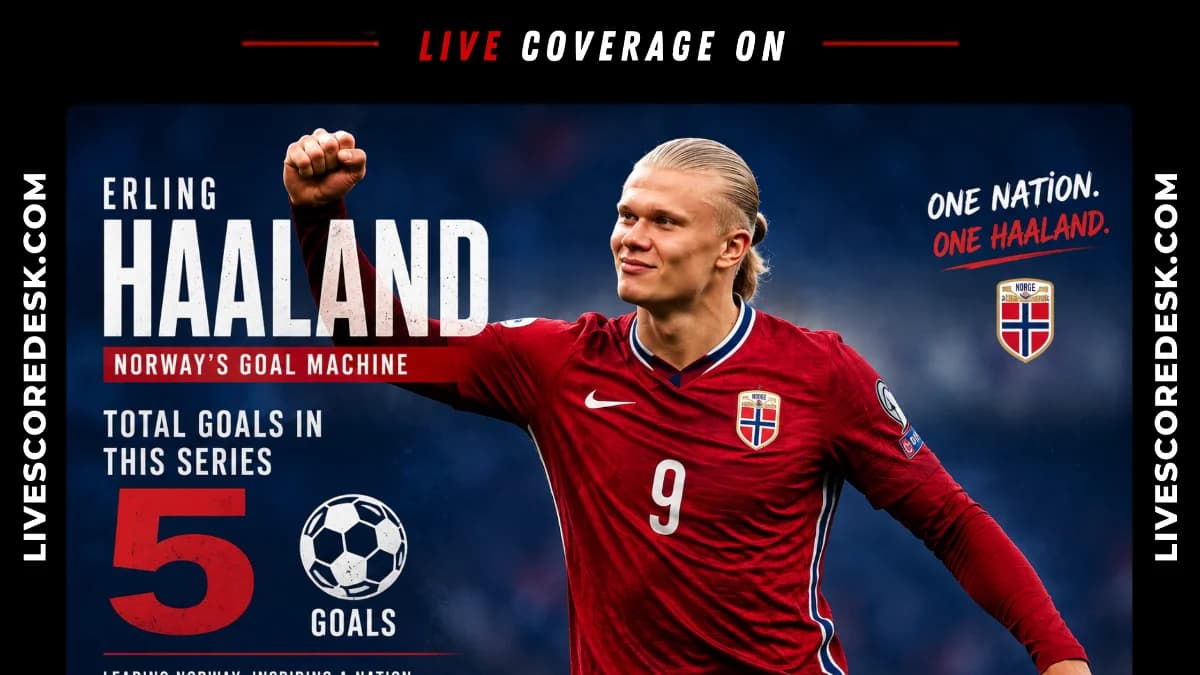
Can England's Defence Solve the Erling Haaland Problem?
England's World Cup quarter-final presents a familiar challenge with much bigger consequences: how do you limit Erling Haaland over 90 minutes? The Manchester City striker has spent years proving that defenders rarely stop him completely. The question is usually whether they can reduce the damage.
Norway's progress to the last eight has highlighted more than Haaland's goals. It has shown a team comfortable building around one of the world's most clinical finishers while still finding contributions across the pitch. England arrive with greater squad depth, but recent performances have also exposed moments of defensive vulnerability that Haaland is uniquely equipped to exploit.
Why Haaland Demands A Different Defensive Plan
Most elite forwards influence games by constantly asking for possession. Haaland often does the opposite. He can remain on the edge of the action before accelerating into space at exactly the right moment, forcing defenders to make split-second decisions.
That movement changes the way opponents defend. Centre-backs hesitate over whether to track him tightly or protect the defensive line, while full-backs become reluctant to push forward. The result is often uncertainty rather than outright mistakes, and Haaland has built his reputation on punishing hesitation.
"Haaland rarely needs many chances because his movement creates high-quality opportunities."
England Have Answers — But Also Questions
England possess defenders who know Haaland's game well through Premier League football. That familiarity should help in recognising his preferred runs, aerial strength and timing inside the penalty area.
Yet knowledge alone has rarely been enough throughout his career. England's defensive structure will be tested as much as individual marking. If defenders focus exclusively on Haaland, space can emerge elsewhere for Norway's supporting attackers.
Thomas Tuchel's side has generally looked organised, but transitions remain an area opponents have targeted. Preventing quick deliveries into Haaland will be as important as challenging him once the ball reaches the box.
Martin Ødegaard Could Be Just As Important
Much of the attention naturally falls on Haaland, but Norway's captain Martin Ødegaard remains the team's chief creator. His vision between the lines and ability to release runners quickly give Haaland the service he thrives upon.
Rather than attempting ambitious passes throughout every attack, Norway have often shown patience before accelerating play with one incisive ball. That partnership means England's midfield will have as much responsibility as the back four.
If Ødegaard is denied time to dictate possession, Haaland's supply becomes more limited. If he escapes pressure, Norway's striker requires only a fraction of a second to become dangerous.
History Shows Elite Strikers Decide Knockout Matches
World Cups have repeatedly been shaped by outstanding centre-forwards producing defining moments under pressure. From Ronaldo in 2002 to Miroslav Klose's remarkable tournament scoring record, elite finishers have often separated evenly matched teams.
Haaland is seeking to establish himself in that tradition. Although club football has already brought him domestic titles and individual scoring records, success with Norway would represent a different achievement altogether.
For England, the challenge extends beyond stopping one player. Containing Haaland while maintaining enough attacking ambition to win the match will define their tactical balance.
| Category | Record |
|---|---|
| Competition | FIFA World Cup 2026 Quarter-final |
| England manager | Thomas Tuchel |
| Norway captain | Martin Ødegaard |
| Key tactical battle | England's central defence vs Erling Haaland |
The Quarter-final May Be Decided Away From The Ball
The defining moments may arrive when Haaland is not touching possession. His positioning constantly influences defensive lines, creating uncertainty that Norway can exploit through runners arriving from midfield or wide areas.
England's objective will therefore be twofold: reduce Haaland's opportunities while maintaining enough attacking intent to prevent Norway from controlling the game's rhythm.
Whichever side succeeds in imposing its preferred style will move one step closer to the World Cup semi-finals. England possess greater squad depth on paper, but knockout football regularly rewards efficiency rather than dominance, and few players have demonstrated greater efficiency in front of goal than Erling Haaland.