
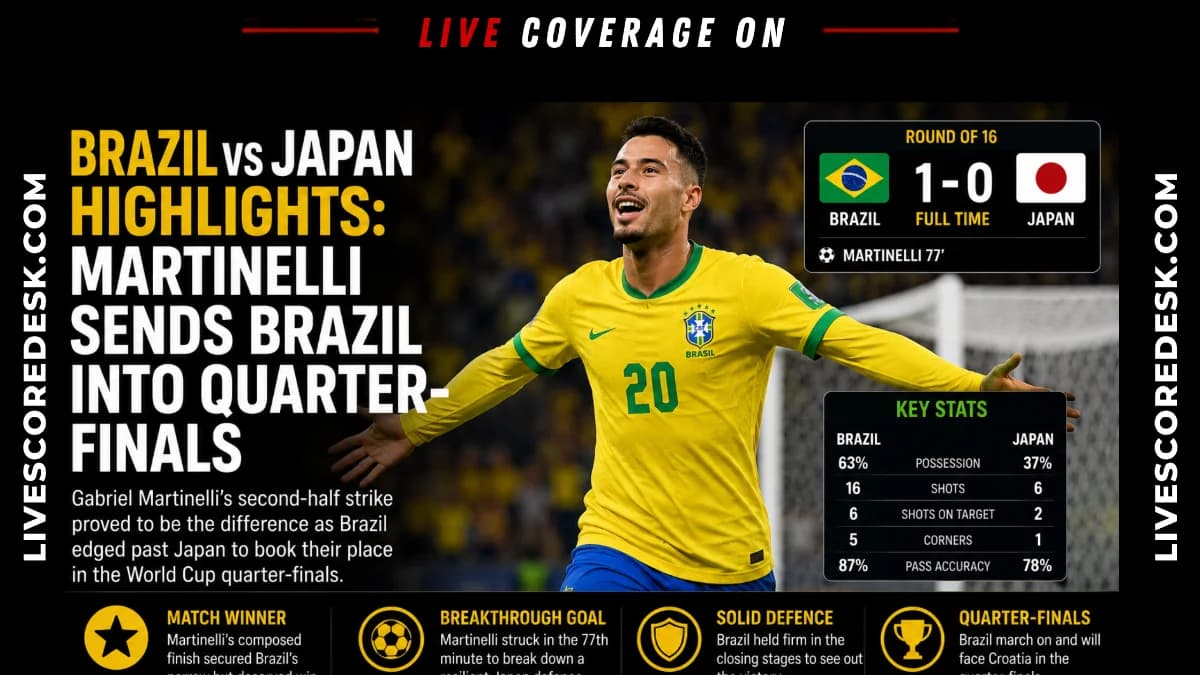
Brazil vs Japan FIFA World Cup 2026: Martinelli's Late Winner Sends Brazil Into Quarter-finals
Brazil's greatest strength remains their refusal to accept defeat, and Japan discovered that the hardest way possible.
Ninety-five minutes were on the clock when Gabriel Martinelli finally broke Japanese hearts in Houston. Brazil had spent almost the entire evening chasing the game, dominating possession without reward, watching chance after chance disappear against a disciplined blue wall. Then came Bruno Guimarães' perfectly weighted pass, Martinelli's calm finish into the bottom corner, and another chapter of Brazilian World Cup resilience was written.
It wasn't Brazil's smoothest performance. It may, however, have been their most important of the tournament. Against arguably the most organised defence they have faced so far, Carlo Ancelotti's side found a way to survive, recover and eventually eliminate one of the competition's biggest surprise packages with a dramatic 2-1 victory.
Japan arrived carrying genuine belief. The Samurai Blue had gone unbeaten through the group stage, including an impressive victory over Tunisia and draws against the Netherlands and Sweden. They also carried history into Houston, having beaten Brazil 3-2 in an international friendly just eight months earlier. Another upset would have delivered Japan's first-ever FIFA World Cup knockout victory.
Instead, Brazil reminded everyone why five World Cup stars still carry weight.
Kaishu Sano's Counterattack Changed the Entire Contest
Brazil controlled possession almost immediately after kick-off. Vinícius Júnior repeatedly attacked the left flank, Bruno Guimarães dictated the tempo, while Matheus Cunha and Lucas Paquetá tested goalkeeper Zion Suzuki from distance. The pressure kept building. The breakthrough never came.
Japan waited patiently.
Then, in the 29th minute, one mistake changed everything.
Danilo surrendered possession close to the halfway line. Kaishu Sano reacted instantly, sprinting through midfield before driving beyond Casemiro. Without hesitation, he fired a precise right-footed effort from outside the penalty area into the bottom-left corner beyond Alisson Becker.
Houston fell silent.
Brazil had dominated the opening half-hour, yet Japan led with their first meaningful counterattack. It perfectly reflected Hajime Moriyasu's tactical plan—stay compact, absorb pressure and punish mistakes at pace.
The goal transformed the contest.
Brazil increased the tempo but found no route through Japan's disciplined back line. Vinícius tested Suzuki twice, Paquetá had efforts blocked, while Marquinhos drifted offside during another promising attack. Japan defended with remarkable organisation, forcing Brazil into speculative efforts rather than clear-cut chances.
At half-time, the scoreboard still favoured Japan.
"Japan scored with their first decisive counterattack, but Brazil finished the night with the comeback that mattered most."
Casemiro's Leadership Sparked Brazil's Revival
Carlo Ancelotti's response arrived immediately after the interval.
Endrick had already replaced the injured Lucas Paquetá before the restart, adding direct running to Brazil's attack. More importantly, the tempo increased dramatically. Brazil pressed higher, crossed earlier and committed additional runners into the penalty area.
The equaliser finally arrived in the 56th minute.
After sustained pressure, Gabriel Magalhães delivered an inviting cross into the six-yard box. Casemiro rose above Japan's defenders and powered a header into the roof of the net for his tenth international goal.
It felt inevitable.
Only moments later Vinícius Júnior nearly completed the turnaround himself, smashing an effort against the crossbar as Japan suddenly struggled to escape their own half.
The statistics increasingly favoured Brazil. Corner after corner arrived. Zion Suzuki continued making important saves, while Japanese defenders repeatedly threw themselves into blocks to preserve parity.
Yet Brazil refused to panic.
That patience would define everything that followed.
Brazil continued attacking throughout the final half-hour, but Japan remained dangerous on the break. Ayase Ueda forced Alisson Becker into an important save after Daizen Maeda's assist, while Vinícius and Endrick both came close at the other end.
Carlo Ancelotti's biggest attacking gamble came in the 66th minute when Gabriel Martinelli replaced Matheus Cunha. The substitution injected fresh pace into Brazil's left side, forcing Japan deeper with every passing attack.
The closing stages became relentless.
Brazil won a succession of corners, Bruno Guimarães kept delivering dangerous balls into the area and Vinícius repeatedly earned free-kicks around the Japanese penalty box. Japan defended bravely, but the pressure rarely eased. Even after Casemiro was forced off injured in stoppage time, Brazil continued committing numbers forward.
Then came the decisive moment.
In the fifth minute of added time, Bruno Guimarães threaded a perfectly timed pass through Japan's exhausted defence. Martinelli timed his run to perfection before calmly placing a right-footed finish beyond Zion Suzuki into the bottom-right corner.
Houston erupted.
After trailing for almost an hour, Brazil had completed another World Cup comeback and denied Japan the historic knockout victory they had chased for decades.
Brazil's Character Wins When Their Football Doesn't
Here's the part nobody's saying out loud: Brazil didn't simply beat Japan because of superior talent. They won because they refused to abandon their attacking identity even after falling behind.
Japan's tactical discipline deserved enormous credit. Their defensive structure frustrated Vinícius Júnior for long periods, Kaishu Sano produced one of the goals of the tournament, and goalkeeper Zion Suzuki delivered several outstanding saves. For more than 90 minutes, they looked capable of creating history.
But knockout football rarely rewards hesitation.
Brazil kept asking questions until Japan finally ran out of answers.
Ancelotti's substitutions changed the rhythm, Casemiro delivered leadership when it mattered most, Bruno Guimarães controlled the closing stages, and Martinelli provided the decisive finish. Those are the moments elite tournament teams consistently produce.
Goalscorers:
- Kaishu Sano (29')
- Casemiro (56')
- Gabriel Martinelli (95')
Top Performer: Gabriel Martinelli (Winning goal after coming on as a substitute)
Brazil's Road Gets Tougher From Here
Brazil now progress to the FIFA World Cup quarter-finals, but this performance also exposed areas that stronger opponents will target. Defensive transitions remain vulnerable, while converting possession into clear chances continues to be inconsistent against disciplined teams.
Japan, meanwhile, leave the tournament with enormous credit. They matched one of football's traditional giants for almost the entire contest, extended their reputation as one of Asia's strongest national teams and demonstrated once again that tactical organisation can narrow even the biggest talent gap.
Brazil survive. Barely.
Yet World Cups rarely remember how favourites reach the next round. They remember only that they did.
For Brazil, this comeback could become the victory that defines their tournament rather than merely extends it.