
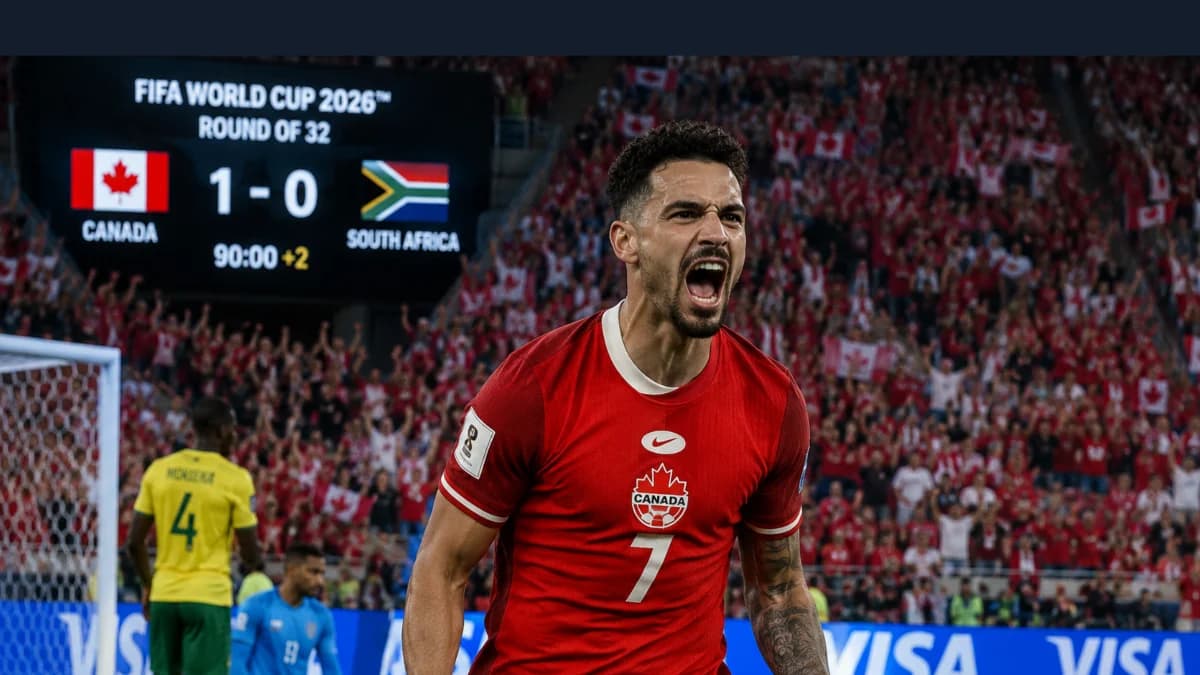
1 goal separated the teams, but it took 92 minutes for Canada to turn territorial control into a historic FIFA World Cup knockout victory. Stephen Eustáquio's stoppage-time strike earned a 1-0 win over South Africa in Los Angeles, sending the co-hosts into the Round of 16 for the first time in their history.
Canada arrived as favourites but found themselves repeatedly frustrated by a disciplined South African defence. Jesse Marsch's side dominated possession for long spells and created the clearer openings, yet the breakthrough refused to come until the closing seconds. South Africa, playing in the nation's first World Cup knockout match, looked increasingly comfortable taking the contest towards extra time before Eustáquio finally broke the deadlock.
Canada's patience finally pays off
The first half followed a familiar pattern. Canada pushed forward, with Jonathan David and Tajon Buchanan constantly probing wide areas, while South Africa defended compactly and looked for counter-attacking opportunities through Evidence Makgopa and Relebohile Mofokeng. Ronwen Williams was called into action several times, while defenders also cleared dangerous efforts off the goal line.
Canada's selection itself drew attention before kick-off. Captain Alphonso Davies, managing a hamstring injury, began on the bench after concerns over his fitness during the group stage. Marsch instead trusted a largely unchanged side that had recovered from defeat to Switzerland to reach the knockout rounds.
The pressure kept building.
South Africa rarely committed too many players forward. Hugo Broos' team defended with organisation and discipline, hoping that one transition could decide the contest. For almost the entire afternoon, that plan looked capable of succeeding
"Canadian heroes."
— Jesse Marsch praised his players after their dramatic late victory
Eustáquio delivers the decisive moment
The breakthrough finally arrived in second-half stoppage time.
A loose ball broke kindly outside the South African penalty area and Stephen Eustáquio reacted quickest, driving a powerful finish beyond Williams in the 92nd minute. The strike transformed a tense knockout contest into one of the biggest moments in Canadian football history.
The match offered an interesting statistical contrast:
- 1.Canada controlled much of the possession but needed a stoppage-time goal.
- 2.South Africa defended resolutely for more than 90 minutes before conceding once.
- 3.Canada progressed to their first-ever World Cup knockout victory.
- 4.South Africa exited after reaching the knockout stage for the first time.
Eustáquio's influence extended beyond the winning strike. The midfielder consistently dictated Canada's tempo, recycling possession and helping maintain sustained pressure throughout the afternoon. His decisive finish ensured that dominance was eventually reflected on the scoreboard.
Historically, this victory carries enormous weight. Canada had never previously won a World Cup knockout match. South Africa, meanwhile, ended their deepest World Cup run despite producing another organised defensive display under Broos.
Canada's historic breakthrough sets up tougher test
Canada now advance to face either the Netherlands or Morocco in Houston on 4 July, another landmark occasion for a team continuing to break new ground on home continent soil. Marsch's squad have already demonstrated resilience by responding to their group-stage defeat against Switzerland with the biggest knockout win in the country's World Cup history — even if it required almost every second available.
South Africa leave the tournament disappointed but with genuine progress to reflect upon. Bafana Bafana reached the World Cup knockout stage for the first time, proving they could compete defensively against elite opposition. Broos also suggested beforehand that this tournament would likely be his final World Cup as a coach, adding further significance to the occasion.
Canada's next challenge will demand greater attacking efficiency. One goal was enough this time. Against stronger opposition, how many clear chances — and goals — will define their place in the quarter-finals?