
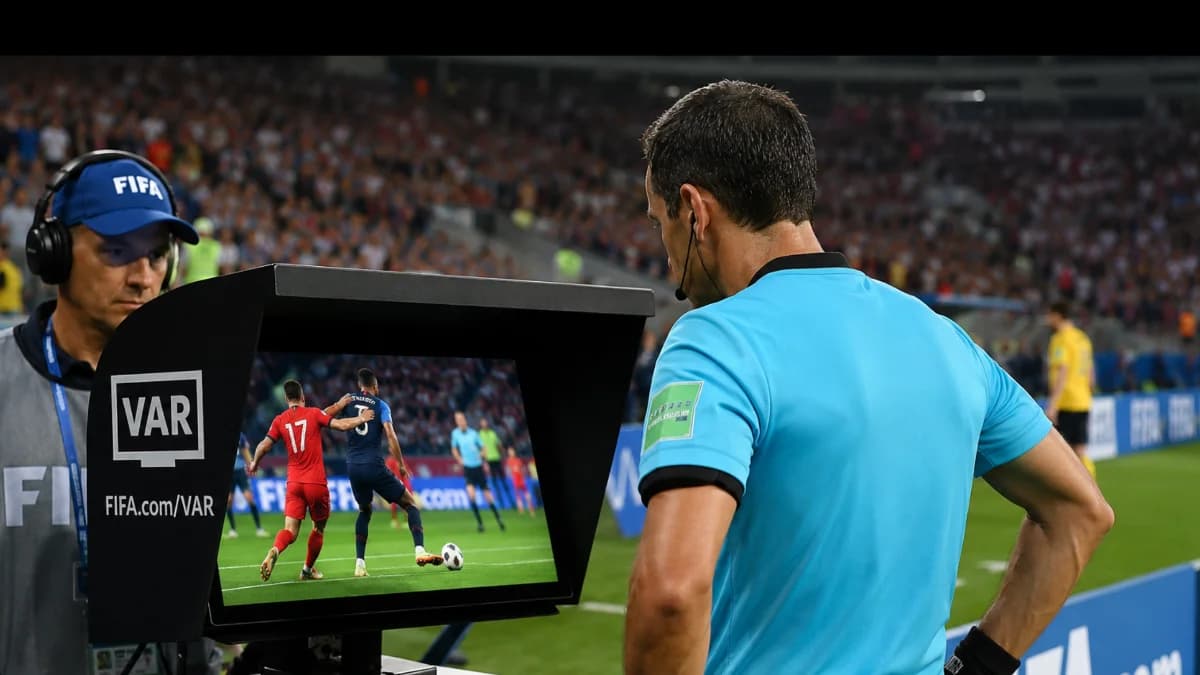
VAR in Football: How Video Assistant Referee Decisions Work
VAR in football has made refereeing more accurate, but it hasn't made it less controversial.
Every weekend, supporters celebrate goals before freezing in anticipation of a silent review. Arms are raised. Players point to imaginary television screens. Stadiums wait. Then comes the verdict. Whether you love it or loathe it, the Video Assistant Referee has fundamentally changed modern football.
What VAR in Football Can Actually Review
The biggest misconception is that VAR checks every refereeing decision.
It doesn't.
Under the protocol approved by FIFA and the International Football Association Board (IFAB), VAR is restricted to only four categories of match-changing incidents:
Everything else remains the responsibility of the on-field referee unless competition-specific regulations provide limited additional powers. The philosophy behind the system is simple: minimum interference, maximum benefit. VAR exists to correct only "clear and obvious errors" or "serious missed incidents," not to re-referee every challenge.
Take a typical example.
A striker scores after a quick counter-attack. Before the restart, the VAR automatically checks whether the scorer was offside, whether the ball went out of play during the build-up, or whether an attacking foul or handball occurred. If everything is legal, the goal stands. If not, the referee is informed immediately.
That's why celebrations sometimes pause for half a minute before the game resumes.
How VAR in Football Reviews a Decision
Here's the part nobody's saying out loud: the referee doesn't lose authority when VAR is involved.
Every match using VAR has a dedicated Video Operations Room where the VAR team watches the live broadcast from multiple camera angles. Throughout the game, officials perform continuous silent checks on every potentially reviewable incident.
If the VAR believes the referee has made a clear and obvious error—or missed a significant incident—they communicate through the referee's headset.
From there, one of three things happens:
Why Offside Decisions Look Different
Offside reviews are often the quickest and most frustrating for supporters because they appear highly technical.
Unlike subjective fouls, offside is largely factual.
Modern FIFA competitions use semi-automated offside technology alongside VAR, combining specialised cameras and connected match balls to identify players' positions more quickly than traditional manual line drawing. The technology alerts the VAR when an attacker is in an offside position before officials confirm the recommendation.
For example, if a winger scores after receiving a through ball, the VAR immediately checks the exact frame when the pass was played. If any part of the attacker's body legally capable of scoring extends beyond the second-last defender, the goal can be ruled out.
That decision usually doesn't require the referee to watch the monitor because it's considered factual rather than subjective.
When VAR Reviews Penalties and Red Cards
Penalty incidents create the greatest debate because football contains plenty of grey areas.
Suppose a defender appears to trip an opponent inside the box.
If the referee awards a penalty and the VAR agrees the contact supports that decision, play continues.
But if replay clearly shows the attacker initiated the contact or there was no foul at all, the VAR may recommend an on-field review. After watching the incident, the referee may overturn the original call.
Direct red cards follow a similar process.
VAR can intervene if a dangerous tackle deserving dismissal is missed entirely or if a player is incorrectly shown a straight red card. Routine yellow-card decisions remain outside its standard scope because the protocol deliberately limits intervention to match-changing moments.
Quick Reference: VAR in Football
Why VAR in Football Still Causes Controversy
Technology cannot eliminate subjectivity.
That's the uncomfortable reality.
A replay can show exactly where contact occurred, but it cannot always answer whether that contact was sufficient for a foul. Different referees may legitimately interpret the same incident differently.
Critics also argue that lengthy reviews interrupt momentum and diminish spontaneous goal celebrations. Supporters often don't understand what officials are reviewing because communication inside stadiums has historically been limited.
On the other hand, governing bodies argue that accuracy has improved significantly since VAR entered the Laws of the Game in 2018, and FIFA continues refining technology to reduce delays through innovations such as semi-automated offside detection and connected match balls.
Recent tournaments have also focused on speeding up reviews rather than increasing the number of interventions, reflecting criticism that lengthy stoppages can damage the flow of matches.
Common Questions About VAR in Football
Can VAR review every foul?
No. Only incidents falling within the approved review categories can trigger intervention.
Does VAR make the final decision?
No. The referee remains the final decision-maker throughout the match.
Why isn't every controversial incident reviewed?
Because IFAB deliberately restricts VAR to correcting clear and obvious errors in match-changing situations rather than re-officiating the entire game.
Why do some reviews happen without the referee visiting the monitor?
Objective decisions, such as factual offside calls, can often be communicated directly. Subjective decisions usually require an on-field review.
The Bottom Line on VAR in Football
VAR in football isn't designed to remove every argument. It never was.
Its purpose is narrower: correcting the biggest mistakes while leaving the referee in charge. The debates over handballs, penalties and marginal offsides will continue because football remains a sport built on judgement as much as technology. But understanding when VAR can intervene—and when it can't—makes those controversial moments far easier to follow.