
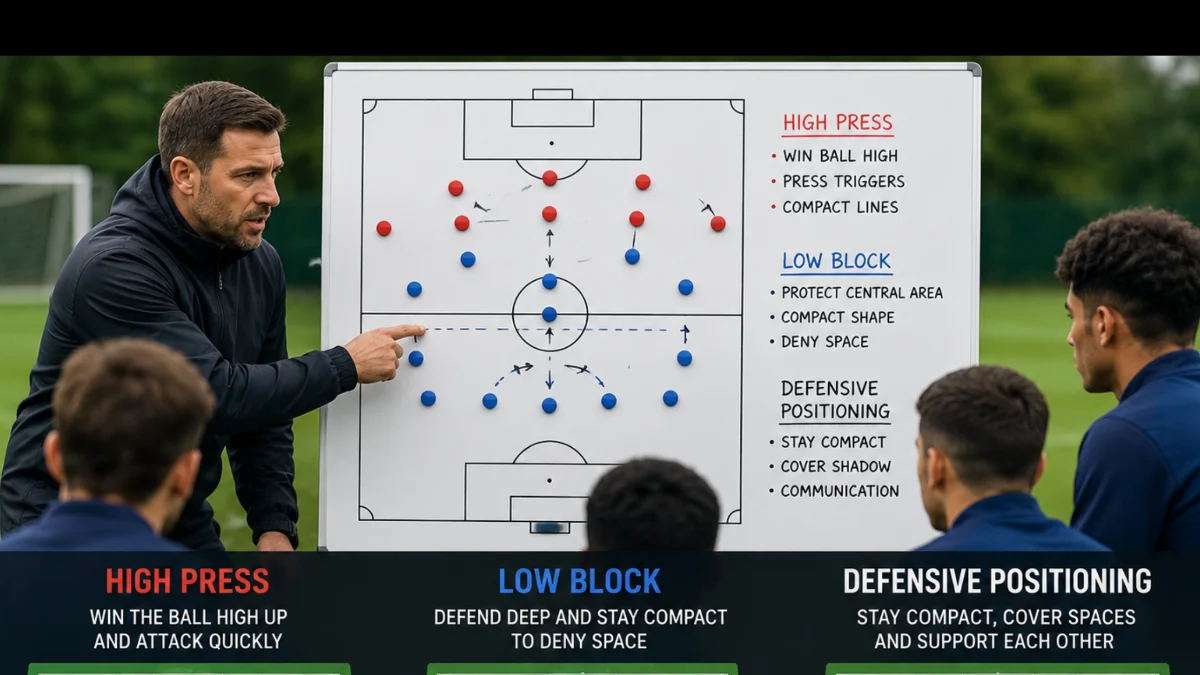
Football Tactics 101: Defensive Strategies, Pressing & Positioning Explained
Football tactics have changed dramatically over the last two decades, but one question still confuses many supporters: why do some teams defend aggressively high up the pitch while others sit deep and wait? Understanding defensive strategies, pressing and positioning transforms how you watch a match. Suddenly, a team isn't simply "attacking" or "defending"—every player's movement has a purpose.
Whether you're new to football or looking to understand why managers like Pep Guardiola, Diego Simeone, Jürgen Klopp or Carlo Ancelotti organise their teams so differently, this guide explains the tactical principles behind modern defending in clear, practical language. Rather than memorising formations, you'll learn the ideas that shape elite football today.
Football Defensive Strategies: Why Defence Starts Without the Ball
Many fans think defending begins only when the opposition reaches the penalty area. Modern football says otherwise.
Every defensive system starts the moment possession is lost. Teams immediately decide whether to win the ball back quickly, delay the attack or retreat into shape. That decision defines their tactical identity.
Some clubs press immediately after losing possession. Others prioritise compactness before attempting to regain control.
A good defensive strategy isn't simply about making tackles.
It's about reducing space.
If attackers have little room to receive, turn or pass, they're forced into mistakes. That's why coaches often talk about "controlling space" rather than "marking players."
Think of two identical attacks.
One reaches the penalty area with five passing options available.
The other reaches the same area with every passing lane blocked.
The defending team has already won half the battle without touching the ball.
Modern football revolves around this principle.
Football Defensive Strategies: Understanding Defensive Shape
The phrase defensive shape appears constantly during football broadcasts, but what does it actually mean?
Defensive shape describes how all eleven players position themselves when their team doesn't have possession.
Instead of chasing the ball individually, players move together as one unit.
Imagine a rubber band connecting every player.
When the ball moves wide, the entire team shifts together.
When it moves centrally, everyone compresses towards the middle.
This coordinated movement prevents opponents finding easy passing lanes.
Low Block
One of the most recognisable defensive systems is the low block.
Here, defenders remain close to their own penalty area while midfielders sit just ahead of them.
The objective isn't to dominate possession.
Instead, the team protects dangerous central spaces and forces opponents into crossing from wide positions.
Managers such as Diego Simeone have often used versions of this strategy with great success.
A low block works particularly well against technically stronger opponents because it reduces the space available behind the defence.
However, it also means accepting long periods without the ball.
Mid Block
The mid block sits between aggressive pressing and deep defending.
Instead of defending inside their own penalty area, players organise themselves around the halfway line.
They wait patiently until opponents enter certain areas before applying pressure.
Many international teams prefer this approach because it balances defensive security with counter-attacking opportunities.
High Defensive Line
Some teams defend far higher up the pitch.
Rather than retreating, defenders position themselves close to the halfway line.
The benefits are significant:
- shorter distances between defence and midfield
- easier pressing
- quicker ball recovery
- sustained attacking pressure
The obvious risk?
Space behind the defence.
Fast forwards can exploit this with well-timed runs.
Because of that, teams using high defensive lines rely heavily on communication, pace and an accurate offside trap.
Football Pressing: How Teams Win the Ball Back
Pressing is one of football's most discussed tactical concepts.
Simply put, pressing means attempting to regain possession immediately rather than allowing opponents time to build attacks.
Not every press looks the same.
Different managers use different triggers.
High Press
A high press begins inside the opponent's defensive third.
Forwards don't wait near halfway.
Instead, they actively close down centre-backs and goalkeepers.
The objective is simple:
Force mistakes close to goal.
Liverpool under Jürgen Klopp became famous for this approach, particularly during their Premier League and Champions League-winning seasons.
The forwards pressed first.
Midfielders followed.
Defenders pushed high.
The entire team squeezed space until opponents had almost nowhere to pass.
When executed properly, possession is often recovered within seconds.
Counter-Pressing (Gegenpressing)
One of the biggest tactical innovations of modern football is counter-pressing, often known by its German name, gegenpressing.
Instead of retreating after losing possession, players immediately surround the ball carrier.
The theory is straightforward.
The opponent has only just won possession and is often disorganised.
Winning it back immediately is easier than allowing them to build an attack.
Pep Guardiola has frequently described the first few seconds after losing possession as one of the best opportunities to defend.
Rather than chasing back 50 metres, his teams attempt to recover possession almost instantly.
Pressing Triggers
Teams don't press constantly.
Doing so would exhaust players.
Instead, coaches use pressing triggers.
These are moments when everyone knows to attack the ball aggressively.
Common triggers include:
- - a poor first touch
- - a backwards pass
- - a pass to the goalkeeper
- - a player receiving possession while facing their own goal
- - a slow switch of play
Once the trigger appears, multiple players press together.
If only one player presses, opponents simply pass around him.
Effective pressing always depends on teamwork.
Football Positioning: Why Players Rarely Stand Still
One of the biggest misconceptions among new supporters is believing positions describe where players stand.
They don't.
They describe responsibilities.
Modern football is built on constant movement.
A full-back may appear as a winger.
A midfielder might drop between centre-backs.
A striker could spend several minutes defending near the halfway line.
Good positioning depends on three questions:
- - Where is the ball?
- - Where are my teammates?
- - Where is the danger?
- Elite players constantly adjust these answers every few seconds.
- They aren't reacting randomly.
They're following tactical principles rehearsed repeatedly during training.