
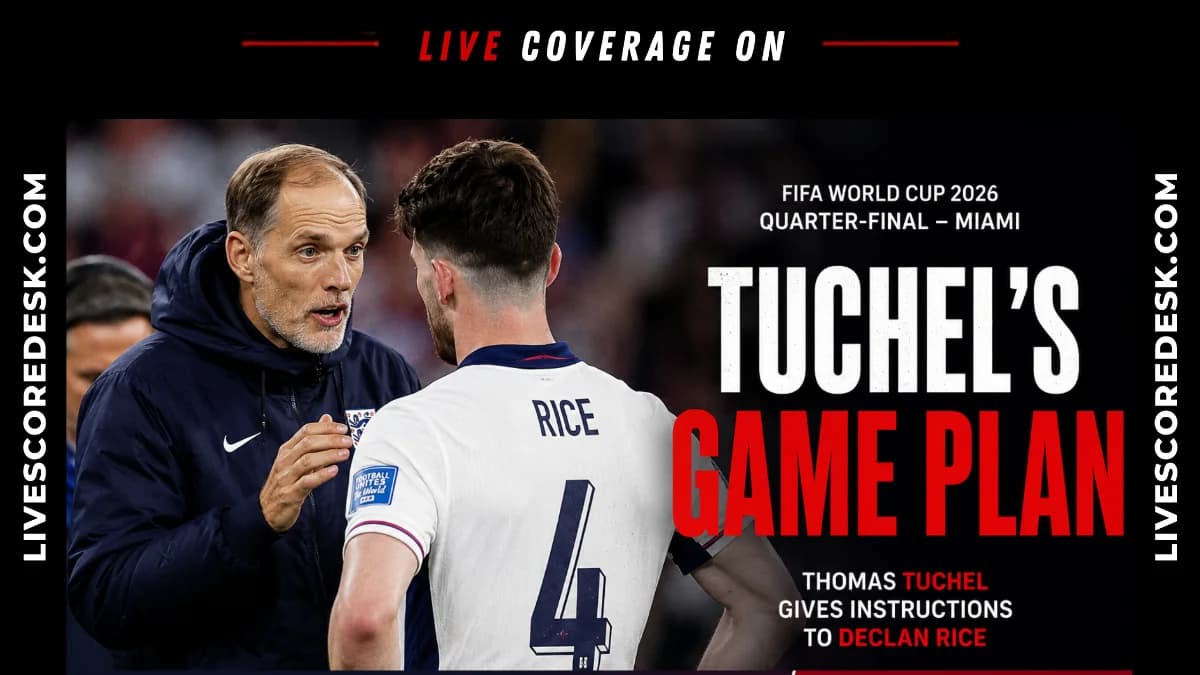
England manager Thomas Tuchel has revealed that Declan Rice's half-time withdrawal against Norway was a tactical decision influenced by the midfielder's recent illness rather than an injury sustained during the match. The England boss said replacing Rice allowed his side to become more attacking before eventually securing a 2-1 extra-time victory that booked a FIFA World Cup 2026 semi-final against Argentina.
Rice started despite missing training earlier in the week after being struck down by a sickness bug, while also managing a hamstring concern. Although the Arsenal midfielder indicated he could continue into the second half, Tuchel opted to substitute him alongside winger Noni Madueke at the interval, introducing fresh legs as England searched for a route back after trailing 1-0.
Tuchel Wanted England To Attack Earlier
Tuchel explained that the substitutions had been planned before England equalised, insisting the decision was driven by the game's tactical demands rather than panic.
The England manager admitted he wanted Bukayo Saka on the pitch to provide greater attacking threat and believed his team required one fewer midfielder in order to increase pressure on Norway's defence.
Speaking to talkSPORT after the match, Tuchel said.
"It was just a one-on-one and we wanted to get a bit more offensive. I took the decision when we were 1-0 down. I didn't want to take it back just because of the goal."
"We knew that Declan was struggling. He gave a green light to continue maybe until the next water break, but then I thought if we go 120 and I don't have Elliot on the field, we will get into trouble in substitutions later."
England Progress But Performance Leaves Questions
Although England reached the World Cup semi-finals, Tuchel admitted the performance itself fell below his expectations.
The German praised his squad's resilience and the impact made by substitutes but acknowledged that both England and Norway produced a match lacking consistent quality.
"Part of me is incredibly proud of the players and the group and the mentality again and the team spirit to overcome adversity,"
Tuchel said.
"There's another part at the moment that I thought the game was not on the highest level from both teams. I think we could have done better in many moments."
"We were lucky in certain moments... I still think overall we deserved it, no doubt about it."
— Thomas Tuchel
Tuchel Admits England Benefited From Fortune
Tuchel also acknowledged that England rode their luck during key moments of the quarter-final.
He pointed to a dangerous first-half turnover that could have left England trailing by two goals before the interval, as well as a Norway goal that was later ruled out after a VAR review.
The England manager stressed there was nothing wrong with admitting fortune had played a part in knockout football.
According to Tuchel, England deserved to progress overall but also created unnecessary difficulties through their own mistakes.
His comments echoed a balanced assessment rather than outright criticism, recognising both the team's fighting spirit and the areas requiring improvement before facing Argentina.
What This Means
Rice's substitution appears unlikely to affect his availability for the semi-final, with Tuchel making clear the midfielder's withdrawal was part of workload management after illness rather than a fresh injury.
England now advance to a World Cup semi-final against Argentina, where Tuchel will hope to welcome a fully fit Rice after carefully managing his minutes in the quarter-final. The manager's willingness to make bold tactical decisions at half-time also underlines his readiness to prioritise the team's long-term needs over individual performances during the tournament.