
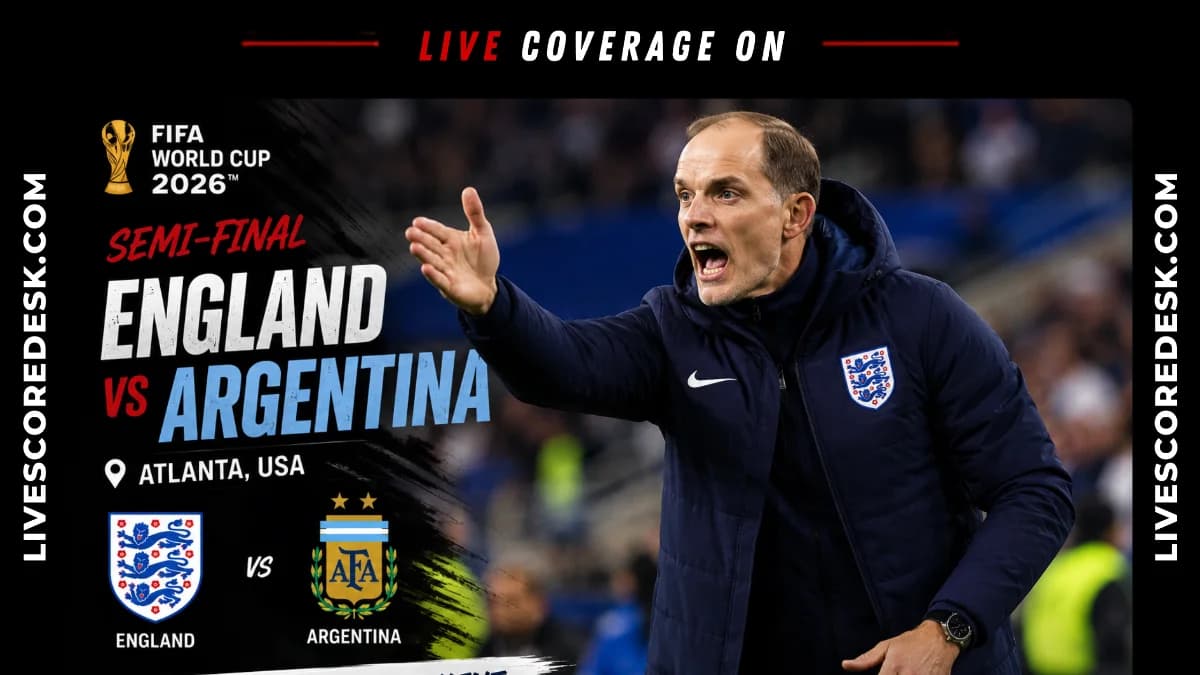
12% Possession: Did Thomas Tuchel's Tactics Cost England a World Cup Final?
By Kartik Sharma | Data Analyst & Reporter
Twelve per cent. That's England's possession after Anthony Gordon's 55th-minute goal until Lautaro Martínez's stoppage-time winner, and it sits at the centre of the debate over Thomas Tuchel tactics. England didn't just lose 2-1 to Argentina in the FIFA World Cup 2026 semi-final; they surrendered control of a match they had spent an hour managing effectively.
The defeat in Atlanta has triggered questions that extend beyond one result. Was England beaten by Lionel Messi's brilliance and Argentina's persistence, or did Tuchel's conservative tactical switch invite the pressure that ultimately ended their hopes of reaching a first World Cup final since 1966? Reuters, Sky Sports and other leading outlets have all highlighted England's dramatic drop in possession and attacking intent after taking the lead.
The Tactical Retreat That Changed Everything
England's original game plan largely worked. Elliot Anderson and the midfield restricted Messi's influence for long spells, while Anthony Gordon rewarded Tuchel's selection with the opening goal in the 55th minute. Up to that point, England looked organised and composed.
Then the match changed.
Tuchel introduced Ezri Konsa and shifted towards a back five, replacing one of England's main counter-attacking threats. According to Sky Sports, England already had only 17% possession in the period immediately after scoring, but the tactical adjustment accelerated the trend. Between Konsa's arrival and Martínez's winner, England's possession reportedly fell to around 7%, while Argentina dominated territory.
A comparison highlights the issue:
“Holding on isn't enough.”
Tuchel's Defence And The Counter-Argument
The criticism is understandable, but football rarely turns on one tactical decision alone.
Tuchel defended his approach afterwards, arguing Argentina increased their risks after falling behind and shifted the momentum naturally. He rejected suggestions that England's defeat reflected any psychological "curse", insisting it should be analysed purely in football terms while accepting responsibility for the outcome.
There is another side to the debate.
Argentina are the reigning world champions and possess Lionel Messi, who repeatedly punishes teams late in matches. Even while England were defending well, Argentina continued creating territorial pressure. Once Messi drifted into wider areas, England's marking became more difficult and the World Cup holders finally broke through via Enzo Fernández before Lautaro Martínez headed home the winner in stoppage time.
History also suggests England have struggled in similar situations. This became another knockout defeat after leading, echoing painful collapses in previous major tournaments. Tuchel arrived promising bolder football than Gareth Southgate's England, making the defensive switch even more open to scrutiny because it appeared to contradict that philosophy.
Stats
What Comes Next For Thomas Tuchel?
Tuchel has already confirmed he intends to remain England manager through Euro 2028 despite the semi-final heartbreak. The Football Association now faces no immediate managerial decision, but every tactical choice in future knockout matches will inevitably be measured against what unfolded against Argentina.
England still possess one of Europe's strongest squads, and much of Tuchel's tournament work earned praise before the semi-final. Yet knockout football is remembered by defining moments rather than overall progress. His substitutions and tactical retreat have become those defining moments. The next major question isn't whether England can reach another semi-final—it is whether Tuchel will trust his team to keep attacking when protecting a one-goal lead. And when that moment arrives again, what possession percentage will define England's future?