
T20 vs ODI vs Test Cricket: Differences Every Fan Should Know
9 out of 10 new cricket fans first ask one question: what's the difference between T20, ODI and Test cricket? The answer is simple. All three formats follow the same basic Laws of Cricket, but they differ in overs, match duration, tactics, player roles and the skills required to win. Understanding these differences makes every match easier to follow, whether it's the ICC Men's T20 World Cup, the Cricket World Cup or the ICC World Test Championship.
Cricket has evolved dramatically since the first Test match was played in 1877. One Day Internationals (ODIs) arrived in 1971 to produce a result in a single day, while Twenty20 (T20) cricket debuted in 2003 as a faster, entertainment-focused format. Today, the International Cricket Council (ICC) recognises all three as official international formats, each with its own unique identity. Test cricket rewards patience and technique, ODIs strike a balance between attack and strategy, and T20 cricket demands instant impact from every player.
How Match Length Changes Everything
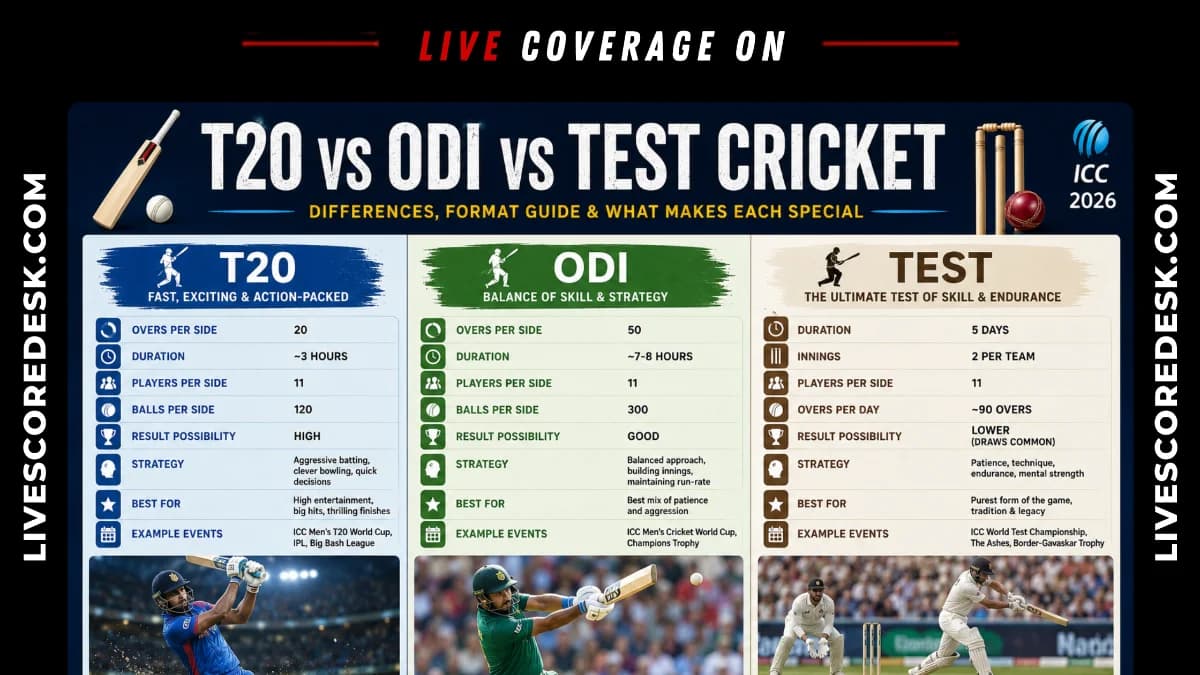
That single difference shapes every tactical decision. In T20 cricket, batters attack from the first over because only 120 legal balls are available. ODI teams typically divide an innings into three phases—Powerplay, middle overs and the final death overs—to balance aggression with wicket preservation. Test cricket removes the pressure of a limited over count, allowing teams to build long innings, wear down bowlers and adapt to changing pitch conditions.
A simple comparison highlights the contrast:
Why Each Format Requires Different Skills
Although the rules remain largely the same, the demands on players change dramatically across the three formats.
In T20 cricket, explosive batting is essential. Players often attempt innovative strokes such as ramps, scoops and switch hits to maximise scoring opportunities. Bowlers rely heavily on slower deliveries, yorkers and variations to restrict runs, while fielders are expected to save boundaries with athletic catches and dives.
ODI cricket rewards versatility. Batters must judge when to attack and when to consolidate, especially during the middle overs after the initial fielding restrictions. Bowlers need the discipline to complete their full allocation of 10 overs while adapting their plans as conditions change.
Test cricket presents the toughest technical examination. Batters may spend several hours at the crease, leaving deliveries outside off stump and waiting patiently for scoring opportunities. Fast bowlers often deliver lengthy spells with the new ball before reverse swing and spin become influential later in the match. Conditions evolve across five days, meaning teams must continually adjust their tactics.
Unlike T20 cricket, where one over can decide the outcome, Test matches are often defined by sessions rather than moments. A disciplined morning spell or a century built over six hours can prove more decisive than a flurry of boundaries. That's why many players and former cricketers still regard success in Test cricket as the ultimate measure of skill.
(Continue in Part 2 with: inning
Powerplays, Innings and Match Strategy
T20 Cricket: Attack From Ball One
T20 cricket leaves little room for caution. Each team receives just 20 overs (120 legal deliveries), so batters are encouraged to score quickly from the opening over. The first six overs are the Powerplay, during which only two fielders are allowed outside the 30-yard circle. Teams often target this phase to build momentum before the field spreads.
Bowlers are equally specialised. Death-over experts focus on yorkers, slower balls and wide lines to limit scoring in the final overs, where matches are frequently decided.
ODI Cricket: A Balance Between Risk and Reward
One Day Internationals provide more time to construct an innings without losing the urgency of a limited-overs contest. Each side bats for 50 overs, and every bowler can deliver a maximum of 10 overs.
Modern ODI strategy usually follows three phases:
Why Test Cricket Is Called the Ultimate Examination
Test cricket is unique because there is no limit on overs. Instead, each team normally has two innings, and matches are played over five days.
That extra time transforms every tactical decision. Batters can leave deliveries outside off stump without pressure from a shrinking over count. Bowlers work patiently to create chances through sustained accuracy rather than constant variation.
Weather and pitch conditions also become major factors. A surface that favours fast bowlers on day one may help spin bowlers by day four or five. Captains must therefore think well beyond the next over, often planning several sessions ahead.
Historically, many of cricket's greatest performances have come in Test matches because they demand endurance as well as skill. Long partnerships, marathon spells and tactical declarations are all part of the format's appeal.
Quick Reference: Comparing Cricket's Three Formats
| Feature | T20 | ODI | Test |
|---|---|---|---|
| Overs per innings | 20 | 50 | No limit |
| Innings per team | 1 | 1 | Usually 2 |
| Match duration | Around 3 hours | round 7–8 hours | Up to 5 days |
| Primary focus | Fast scoring | Balanced strategy | Endurance and technique |
| Official world event | ICC Men's T20 World Cup | ICC Cricket World Cup | ICC World Test Championship |
| Typical result | Win, loss or tie | Win, loss or tie | Win, loss, tie or draw |
Which Cricket Format Is Best for Beginners?
For someone watching cricket for the first time, T20 is usually the easiest format to understand. The shorter duration, frequent boundaries and constant action make it accessible without requiring deep tactical knowledge.
ODI cricket is the logical next step because it introduces longer-term planning while remaining a single-day contest. Viewers begin to appreciate batting partnerships, bowling changes and the importance of preserving wickets.
Test cricket often takes the longest to appreciate. Not anymore, though. Once you understand why captains set attacking fields, why batters sometimes defend for entire sessions and how changing pitch conditions influence strategy, the format becomes one of sport's richest tactical contests.
Many players have excelled across all three formats, but doing so is increasingly rare. The physical and technical demands differ significantly, leading many international cricketers to specialise in one or two formats rather than all three.
Practical Takeaway
The difference between T20, ODI and Test cricket isn't simply the number of overs—it changes the rhythm, tactics and skills required to succeed. T20 rewards explosive power and innovation, ODI cricket balances aggression with planning, and Test cricket remains the game's deepest examination of technique, temperament and endurance.
Whether you're preparing to watch your first ICC tournament or following domestic leagues around the world, understanding these three formats will make every innings, bowling spell and captaincy decision far easier to follow. As cricket continues to evolve, one question will remain at the heart of every match: which format best showcases the sport's unique blend of strategy, skill and spectacle?