
By Kartik Sharma (KS) — Data Analyst & Reporter
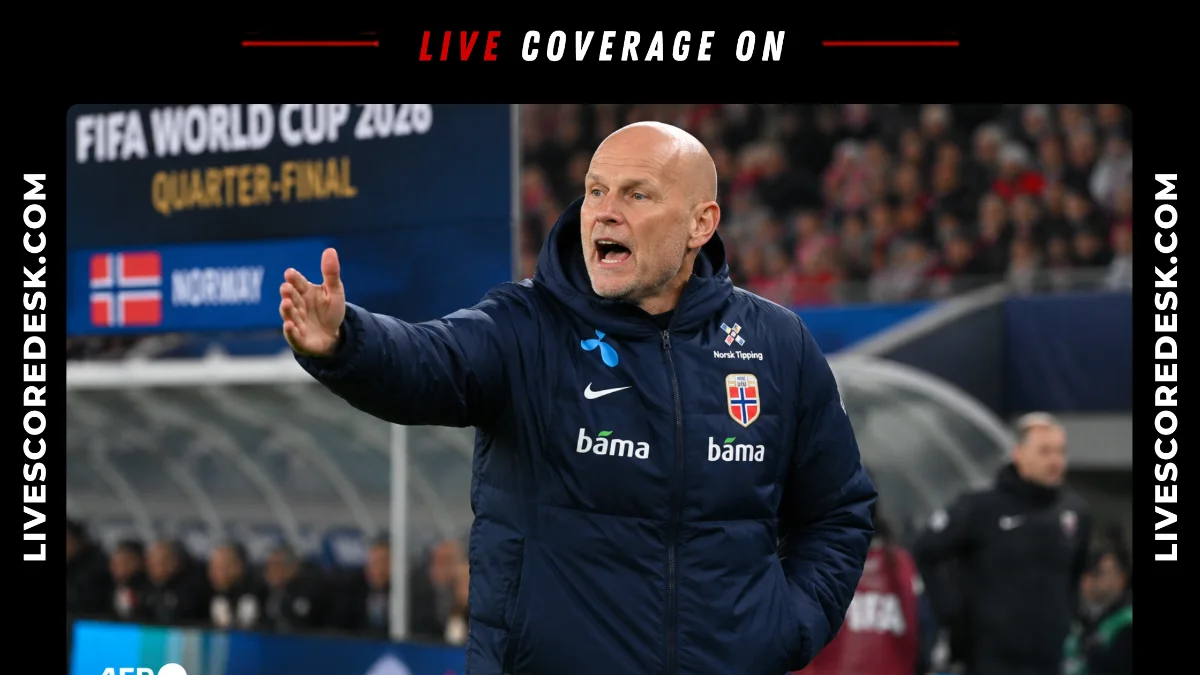
2,001. That's the year Ståle Solbakken's life changed forever. Twenty-five years later, the Norway manager is one win away from guiding his country to its first-ever FIFA World Cup semi-final after surviving a cardiac arrest that left him clinically dead for seven minutes.
Norway's remarkable 2026 FIFA World Cup campaign has turned fresh attention towards the 58-year-old coach's extraordinary story. Solbakken's journey stretches far beyond tactics and team selections. It is one of football's most remarkable recoveries, transforming a life-threatening medical emergency into a coaching career that has revived an entire national team.
Seven Minutes That Changed Everything
On 13 March 2001, Solbakken was playing for FC Copenhagen when he suffered a cardiac arrest during training. His heart stopped, and club doctor Frank Odgaard revived him after approximately seven minutes.
The former midfielder later described the experience on the Drivkraft podcast.
"I remember seeing a blue light and then a tunnel. I remember thinking that I would like to stay there a little longer."
Doctors placed Solbakken in a medically induced coma for 26 hours to protect his brain. He eventually recovered without neurological damage, but examinations revealed a congenital heart defect that immediately ended his playing career.
His family feared the worst.
Speaking to La Gazzetta dello Sport, Solbakken recalled how his parents rushed from Norway to Denmark after hearing the news.
"My parents flew to Denmark straight away. I was told that on the plane my mum started planning my funeral."
A Football Life Rebuilt From The Touchline
Retirement as a player didn't mean the end of Solbakken's influence.
Instead, he began coaching Norway's Under-18 side before taking charge of HamKam. His impact was immediate, guiding the club to an impressive fifth-place finish in Norway's top division.
His coaching rise then accelerated.
Perspective Became His Greatest Strength
"Something like that definitely changes some things. I put everything into my job, but I also know that there are other, more important things."
That perspective has become one of Norway's defining characteristics during the 2026 FIFA World Cup.
The national side narrowly missed qualification for the 2022 World Cup and UEFA Euro 2024. Those failures increased pressure on Solbakken, who publicly admitted he would resign if Norway failed to qualify for the 2026 tournament.
Not anymore.
Instead, Norway reached the World Cup knockout rounds and now stand on the brink of the country's greatest achievement in men's football.
The transformation is measurable. Norway hadn't qualified for a FIFA World Cup since 1998. Now they are preparing for a quarter-final with the chance to become the nation's first men's team to reach the last four.
What This Means For Norway
Solbakken's personal comeback has become intertwined with Norway's football revival.
His squad combines experienced stars such as Erling Haaland and Martin Ødegaard with a disciplined tactical structure that has delivered Norway's deepest World Cup run in modern history.
The story also highlights how dramatically careers can change. Solbakken never returned to professional football as a player, yet his biggest football achievement may arrive from the technical area rather than midfield.
History offers another comparison. Norway's previous best World Cup performance came with qualification for the Round of 16 in 1998. Reaching the semi-finals would establish a completely new benchmark for the national team.
Whether that happens or not, Solbakken's legacy already extends beyond results. His recovery from clinical death, successful coaching career and role in rebuilding Norway have made him one of football's most compelling managerial figures.
The next match could define another chapter. Will the number remembered most become seven minutes, or one historic semi-final?