
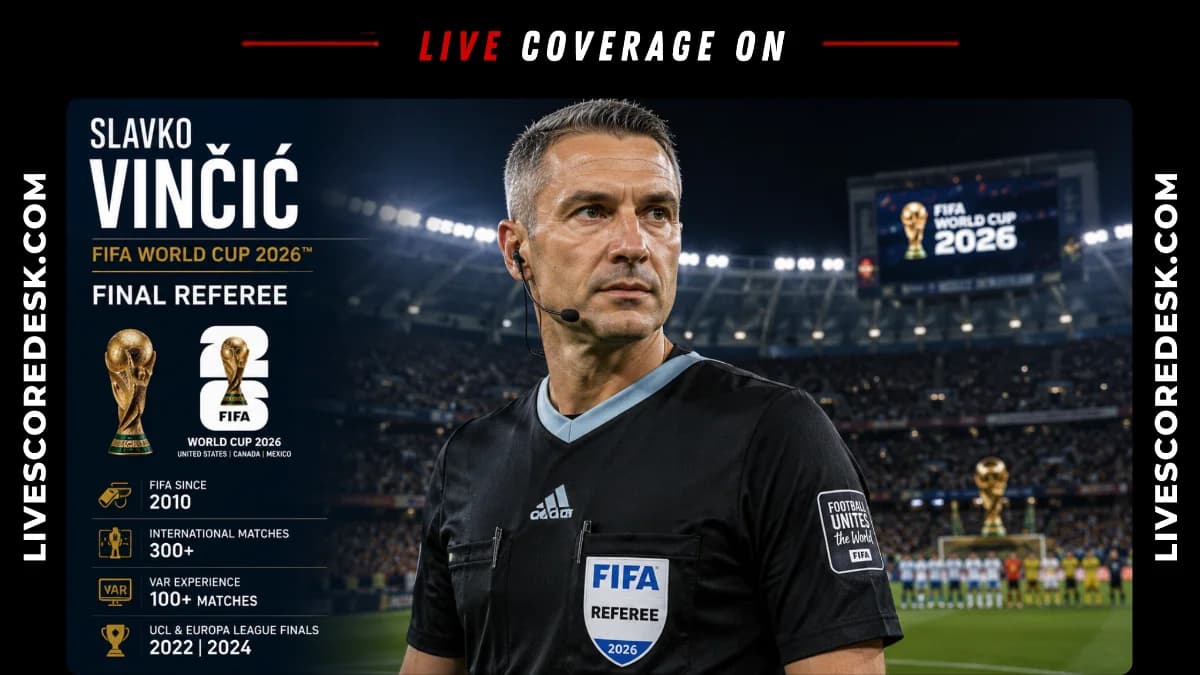
Slavko Vinčić's appointment proves FIFA is backing experience over controversy.
FIFA has appointed Slovenian referee Slavko Vinčić to officiate the 2026 FIFA World Cup final, placing one of Europe's most experienced officials in charge of football's biggest match. The decision has immediately reignited discussion over Vinčić's previous matches involving Argentina, even though FIFA's selection reflects years of trust in his performances at the highest level rather than any single fixture.
The appointment was confirmed ahead of the World Cup final after Vinčić progressed through another successful tournament. While social media has focused on his history with Argentina, the bigger story is FIFA's confidence in an official who has consistently handled elite UEFA and FIFA competitions. Here's the part nobody's saying out loud: referees rarely earn a World Cup final through reputation alone—they do so through sustained excellence across multiple tournaments.
What Led To FIFA's Decision To Appoint Slavko Vinčić?
Vinčić arrives at the World Cup final with one of the strongest résumés among active European referees. The Slovenian has previously taken charge of the UEFA Champions League final, UEFA European Championship matches and several FIFA tournament fixtures, establishing himself as one of the governing body's trusted officials.
His appointment follows a tournament in which FIFA's Referees Committee closely assessed every official on technical accuracy, disciplinary management, communication and consistency. Only a small group of referees remain eligible by the closing stages of a World Cup, with appointments becoming increasingly selective after every knockout round.
Supporters have inevitably revisited Vinčić's earlier Argentina assignments. He has refereed Argentina on multiple occasions in international football, leading some fans to debate whether previous decisions could influence perceptions ahead of another high-profile appointment. Yet no official FIFA review has questioned his impartiality in those matches, and there has been no indication that past appointments counted against his candidacy.
"A FIFA World Cup final is awarded only to referees who consistently meet the highest standards throughout the tournament."
Argentina Connection Sparks Fresh Debate
Much of the reaction surrounding Vinčić's appointment has centred on Argentina rather than the referee himself. Several supporters have pointed to his previous games involving the South American side, analysing decisions frame by frame across social media platforms.
That's hardly unusual. Every World Cup final referee enters the spotlight long before kick-off, particularly when either finalist has encountered that official in previous international competitions. Modern football ensures every major decision is replayed repeatedly through television analysis, VAR footage and online discussion.
The counter-argument deserves equal weight. FIFA has repeatedly maintained that appointments are based solely on merit, tournament performances and neutrality. Officials are monitored throughout the competition, with every major decision reviewed internally before future assignments are made. Vinčić's selection suggests those assessments placed him among the tournament's standout referees rather than viewing his previous Argentina matches as a concern.
Reaction To Slavko Vinčić's Appointment
Football supporters have responded in familiar fashion. Some Argentina fans welcomed the appointment, citing previous matches in which they believed Vinčić managed high-pressure situations well. Others questioned whether any referee with prior history involving a finalist should oversee football's biggest game.
Those concerns are understandable, but they don't automatically undermine FIFA's process. Every elite referee accumulates a history with leading national teams over the course of a career. At World Cup level, avoiding every previous connection becomes increasingly difficult, particularly in the knockout stages where only the highest-rated officials remain available.
FIFA's refereeing system is designed to minimise bias through extensive assessments before, during and after every match. Referees receive detailed performance reviews covering decision-making, positioning, communication and application of the Laws of the Game. Those evaluations—not online debate—determine who progresses to later rounds.
[STATS]
Appointment: Slavko Vinčić named referee for the 2026 FIFA World Cup final
Nationality: Slovenia
Elite Experience: UEFA Champions League, UEFA European Championship and FIFA international tournaments
Selection Process: FIFA Referees Committee assessments based on tournament performances, fitness, consistency and neutrality
What Happens Next
Attention now shifts from the referee to the match itself. Once the final kicks off, Vinčić's task will be the same as every official entrusted with football's biggest fixture: apply the Laws of the Game consistently while managing the pressure that accompanies a global audience of millions.
History shows that World Cup final referees are remembered less for their appointments than for how quietly they control the occasion. An unobtrusive performance is often considered the greatest compliment an official can receive, allowing the players rather than the referee to decide the outcome.
That said, scrutiny will remain intense. Every major decision—from penalty appeals to disciplinary actions and VAR reviews—will be analysed instantly across television broadcasts and social media. Even correct decisions are unlikely to escape debate in an era of slow-motion replays and countless camera angles.
For FIFA, however, the appointment represents confidence rather than controversy. Vinčić has built his reputation through years of officiating elite club and international fixtures, and the governing body has judged him the right person for football's showpiece event. The discussion surrounding his previous Argentina matches may dominate headlines before kick-off, but once the whistle blows, only one standard will matter: whether the game is officiated fairly, consistently and without becoming the story itself.