
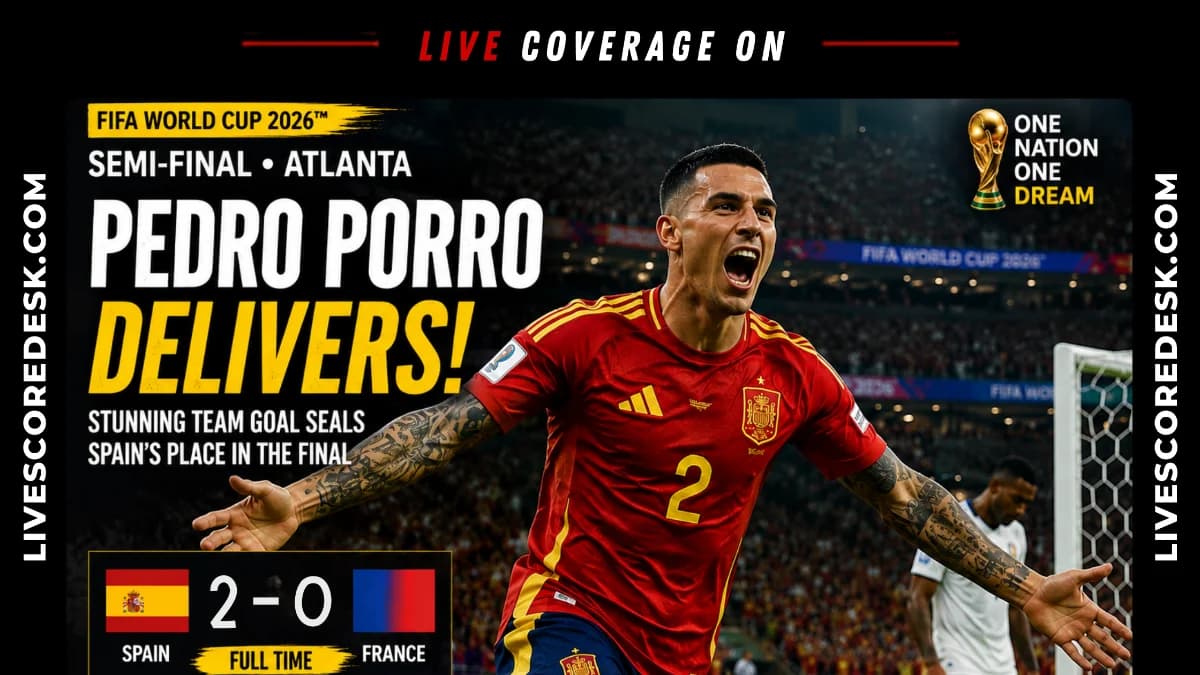
Pedro Porro Goal Shows Why Spain Outclassed France Tactically
By Shivam Kumar | Senior Sports Reporter
Spain's victory over France was defined as much by their collective movement as the 2-0 scoreline. Pedro Porro's goal in the 58th minute became the clearest example of why the reigning European champions reached the FIFA World Cup 2026 final, exposing the technical and tactical shortcomings that France captain Kylian Mbappe later acknowledged after the match.
The semi-final in Atlanta was expected to be decided by fine margins between two of Europe's strongest sides. Instead, Spain controlled possession, dictated the tempo and repeatedly manipulated France's defensive shape. While Mikel Oyarzabal's first-half penalty gave Spain the lead, Porro's second goal illustrated the contrast in organisation, movement and decision-making between the teams. The goal has since become one of the defining tactical moments of the tournament.
Pedro Porro's Goal Exposed France's Defensive Structure
Spain's second goal did not rely on individual brilliance alone. It came from coordinated movement, intelligent positioning and precise passing that France struggled to contain throughout the evening.
The move began deep inside Spain's own possession phase, with Rodri calmly controlling the rhythm in midfield. France initially defended in a compact mid-block, hoping to limit central passing lanes before applying pressure higher up the pitch. For several seconds, the shape remained organised. Then Spain accelerated.
Pedro Porro recognised the opening before most defenders did. Starting from right-back, he launched a perfectly timed overlapping run as Dani Olmo drifted inside to occupy France's central defenders. That single movement forced multiple French players into split-second decisions.
Instead of passing runners between defenders, France reacted individually. Their midfield failed to track Porro's run, while the left side of the defensive unit remained focused on the ball rather than scanning the movement developing behind them.
Spain immediately punished that hesitation.
A sharp forward pass found Olmo between the lines. Without taking extra touches, the midfielder combined with Porro in a quick one-two that bypassed France's defensive block. Dayot Upamecano stepped aggressively towards Olmo, leaving space behind him, but no covering defender filled the gap quickly enough. Porro continued his run into the penalty area completely unmarked before calmly finishing beyond Mike Maignan.
The sequence lasted only a few seconds. Yet it demonstrated Spain's superior understanding of spacing, timing and collective movement far more clearly than any statistic from the match could.
Not anymore did France appear capable of disrupting Spain's rhythm. Instead, they found themselves reacting to every movement rather than dictating play themselves.
Mbappe Admits Spain Controlled the Midfield Battle
"It was difficult for us. Tactically, we had a plan to go for them with pressure, to go one for one, to not let them lead the tempo and play the way they want to play. That's what we let them do."
— Kylian Mbappe
Rodri's Influence Went Beyond Possession
Although Pedro Porro finished the move and Dani Olmo supplied the decisive combination, Rodri remained the player who quietly dictated the contest. The Manchester City midfielder repeatedly positioned himself to receive possession under pressure before switching play or progressing attacks through short, accurate passes.
France attempted to disrupt Spain's build-up by pressing in phases, but Rodri's awareness and composure prevented those efforts from becoming consistent. Rather than forcing risky passes, Spain patiently recycled possession until spaces appeared, then accelerated through combinations that France found difficult to track.
This control resembled the principles that defined Spain's dominant international sides between 2008 and 2012. While this squad has developed its own identity, the emphasis on positional discipline, technical security and intelligent movement remains recognisable.
That comparison should not suggest the two generations are identical. The current side attacks more directly at times and relies on dynamic full-backs like Porro to create overloads. Even so, the underlying philosophy remains centred on collective football rather than individual moments.
France's Tactical Plan Fell Short
France entered the semi-final with one of the tournament's strongest squads, yet Spain consistently exposed small positional errors that became significant over 90 minutes.
The French midfield often arrived a fraction late when Spain progressed through central areas. Their defensive line also became stretched whenever players stepped forward individually instead of moving as a unit. Those issues were particularly visible during Porro's goal, where one aggressive challenge disrupted the entire defensive structure.
Spain deserve considerable credit for creating those situations. Their off-ball movement repeatedly forced France into difficult decisions, while their one-touch passing reduced the time available for defenders to recover their positions.
The result underlined an important distinction between athletic pressing and coordinated pressing. France worked hard throughout the contest, but Spain's superior spacing and technical execution allowed them to bypass pressure with remarkable consistency.
STATS
What Comes Next in This Storyline
Spain now advance to the FIFA World Cup 2026 final, where they will face the winner of England versus Argentina. Their performances throughout the tournament have reinforced their reputation as one of international football's most cohesive teams, combining disciplined defending with technically polished attacking play.
France still have one fixture remaining, meeting the loser of the other semi-final in the third-place play-off. Didier Deschamps and his squad will look to finish the tournament positively, but the defeat also provides clear tactical lessons before attention turns to future international competitions.
For Spain, the challenge now shifts from reaching the final to completing the job. Their display against France demonstrated why they have become one of the tournament favourites, yet one match remains before they can add another World Cup title to their history. The semi-final offered perhaps their clearest statement so far—not through individual brilliance alone, but through a collective performance that consistently outmanoeuvred one of football's strongest nations.