
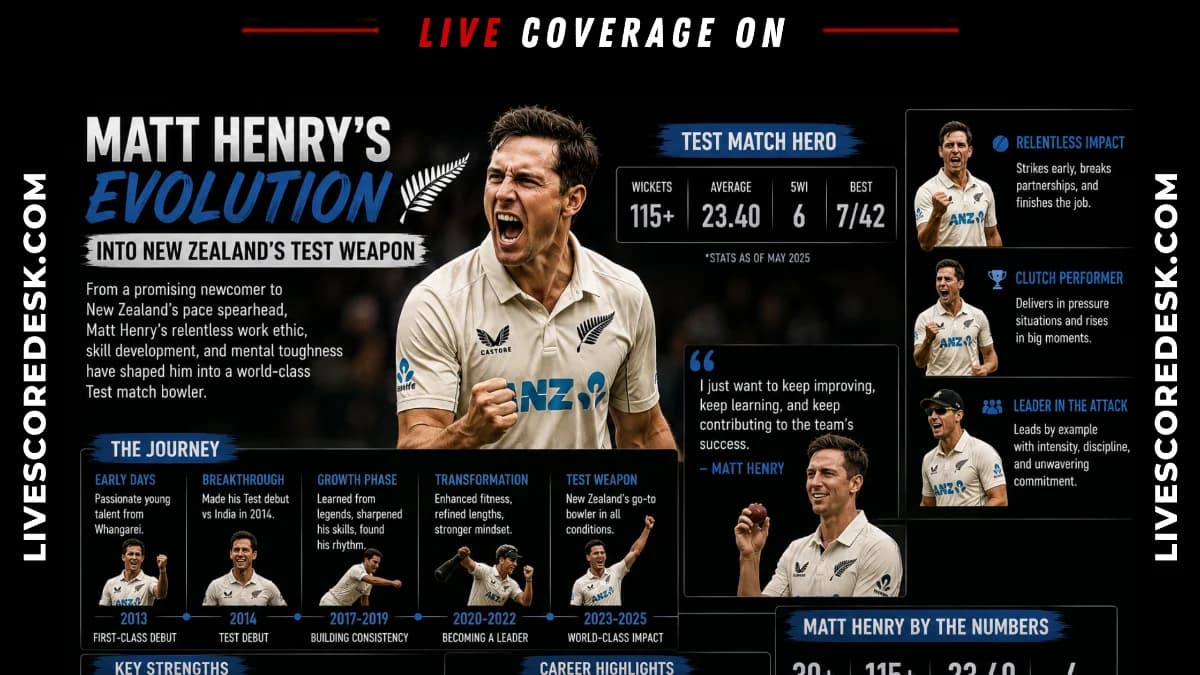
Matt Henry's rise from back-up quick to New Zealand's bowling spearhead has become one of the defining stories of the Black Caps' current Test side.
The debate isn't whether Henry is performing well. The numbers settled that some time ago. The more interesting question is how a bowler who spent large parts of his career waiting behind established names has emerged as arguably New Zealand's most reliable red-ball weapon.
How Matt Henry Became New Zealand's Most Consistent Threat
For much of the previous decade, Henry occupied an unusual position in New Zealand cricket. He was highly regarded, regularly selected in squads and often successful when called upon, yet he spent long periods behind the established pace trio of Trent Boult, Tim Southee and Neil Wagner.
That competition limited his opportunities. While New Zealand benefited from remarkable fast-bowling depth, Henry rarely enjoyed the uninterrupted run that many leading Test bowlers receive during their peak years.
The evidence now suggests those intermittent opportunities are a thing of the past.
At The Oval, Henry's bowling was built less on outright pace than relentless accuracy. England's batters repeatedly found themselves drawn into mistakes by deliveries landing in virtually the same area over and over again. His match figures of 11 wickets reflected both discipline and control, qualities that have increasingly defined the latter phase of his career.
"Back-to-back five-wicket hauls and 11 wickets in the Test match."
The Counter-Argument: Opportunity Matters Too
There is another way to view Henry's transformation.
Some observers argue the bowler himself has not fundamentally changed as much as circumstances around him have. New Zealand's pace attack for years revolved around Boult, Southee and Wagner, leaving limited room for continuity elsewhere. Henry often entered the side for specific conditions, then found himself back on the fringes once senior bowlers returned.
Evidence exists for both interpretations.
On one hand, Henry's control, seam position and tactical awareness appear sharper than during the early stages of his Test career. His success in different countries, including notable performances in recent overseas tours, points towards a bowler operating at a higher level than before.
On the other, regular selection has allowed him to build rhythm and confidence. Fast bowlers frequently speak about the value of consecutive matches, and Henry is now receiving the sustained opportunities that were often unavailable earlier in his international career.
The comparison with previous New Zealand seamers is instructive. Boult brought left-arm swing, Wagner offered relentless short-pitched pressure, and Southee became a master of movement through the air. Henry's strength lies elsewhere. He attacks the top of off stump with remarkable consistency and forces batters into repeated decisions. The method is less eye-catching, but increasingly effective.
There is also a historical precedent within New Zealand cricket. Several fast bowlers, including Richard Hadlee and Southee, produced their most complete Test cricket after accumulating significant experience. Henry, now in his mid-thirties, appears to be following a similar path where refinement has become as important as raw athleticism.
Not overnight. Not through a technical revolution. Through repetition.
That may be the most significant part of the story.
Why The Matt Henry Debate Has Changed
The discussion around Henry used to centre on selection. Should he play? Could New Zealand fit him into their strongest XI? Was he unlucky to miss out?
Those questions have largely disappeared.
Instead, attention has shifted towards where he ranks among the world's most effective Test seamers. His performances in England have reinforced a reputation that was already growing after strong returns in other conditions. According to published records, Henry reached 100 Test wickets in only 26 matches, making him the second-fastest New Zealander to that milestone behind Richard Hadlee.
What Comes Next For Henry And New Zealand
The immediate storyline is straightforward. New Zealand have drawn level in the series after their victory at The Oval, and Henry enters the next Test as the attack's form bowler.
Longer term, the conversation will focus on legacy. Henry spent years operating in the shadow of some of New Zealand's most celebrated seamers. The latest evidence suggests he has moved beyond that comparison.
What remains to be seen is how far this phase of his career can go. The wickets continue to arrive, the control remains intact and, increasingly, opposition batting orders are being measured against him rather than the other way around.
For a bowler once viewed primarily as New Zealand's back-up option, that's a significant shift. And it's now supported by results rather than reputation.