
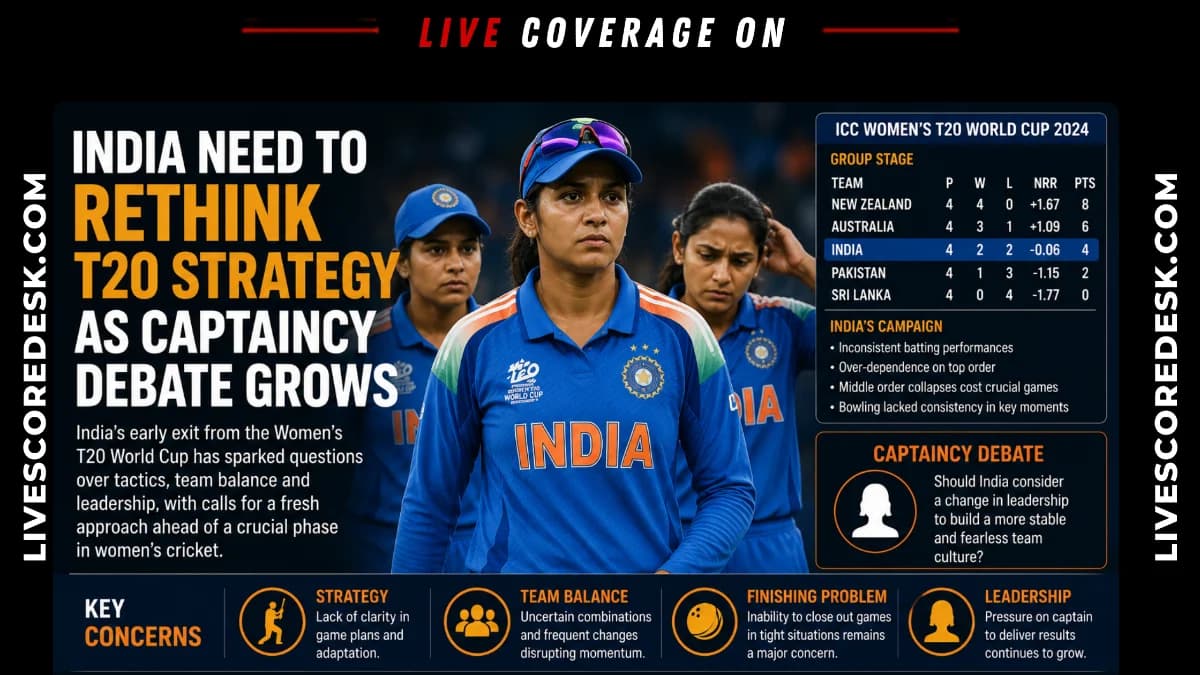
India need to rethink their T20 game – and perhaps captaincy
2 consecutive ICC Women's T20 World Cups have now ended at the group stage for India under Harmanpreet Kaur. That number matters more than any individual innings because it raises a question the selectors can no longer avoid: has India's T20 blueprint fallen behind the world's best?
India's latest campaign ended with defeat to Australia, leaving them outside the semi-finals once again. The result wasn't created by one poor evening alone. Instead, it highlighted familiar issues—unclear batting roles, inconsistent pace bowling, missed chances in the field and an inability to produce their best cricket against elite opposition. Those problems have followed India across successive T20 World Cups despite the rapid growth of women's cricket through the Women's Premier League.
Why India's T20 blueprint needs a reset
The trigger for this debate wasn't only the loss to Australia. India had already placed themselves under pressure after an error-filled defeat against South Africa earlier in the tournament. Dropped catches, missed run-out opportunities and costly overs left them needing to beat Australia to qualify, a situation remarkably similar to the previous edition.
Across the last two Women's T20 World Cups, India's victories have come against Pakistan, Sri Lanka, Bangladesh and the Netherlands. They have repeatedly fallen short against the strongest contenders when qualification has been on the line.
That pattern tells a bigger story than one result.
A quick comparison illustrates the trend:
- 1.2024: Opening defeat to New Zealand forced India into a must-win scenario before losing to Australia.
- 2.2026: Fielding lapses against South Africa created another qualification crisis before Australia ended the campaign.
Different tournaments. The same outcome.
"We didn't play well against good teams"
"If I have to think about the entire tournament, I think we didn't play well against good teams and as a group we really need to rethink what we need to do against them."
group we really need to rethink what we need to do against them."
Harmanpreet Kaur's assessment after the defeat to Australia was notably direct. Rather than blaming one department, she admitted India have repeatedly struggled in decisive moments.
She pointed towards recurring issues in both disciplines. India have conceded easy runs during the closing overs with the ball, while chases have regularly stalled despite promising positions. Those shortcomings have now appeared across multiple ICC tournaments rather than isolated matches.
Leadership isn't the only issue—but it is part of the conversation
Head coach Amol Muzumdar echoed his captain's concerns.
"I think we really have to rethink our strategy or our T20 game. We really need to put our heads around what combination we are going to play."
Selection uncertainty became visible throughout the tournament.
Jemimah Rodrigues and Yastika Bhatia continued moving between No. 3 and No. 5, making role definition difficult. Rodrigues has spent almost her entire T20I career batting at No. 3, while Bhatia has yet to establish herself consistently in either position after 26 T20 internationals spread across five years.
Against Australia, Smriti Mandhana adopted a measured approach, scoring around a run a ball before being run out. India reached 134 for 2 after 18 overs but couldn't fully capitalise despite Harmanpreet producing another fighting innings. The finish never arrived.
That raises another question. Is India's batting order being built around defined roles, or adjusted from match to match?
The WPL has undoubtedly expanded India's talent pool, yet the national side is still searching for another genuine finisher alongside Richa Ghosh.
Injuries haven't helped. Pooja Vastrakar has missed more than a year, while Amanjot Kaur and Kashvee Gautam were unavailable before the tournament. Shreyanka Patil also suffered an injury during the competition. Even so, India's search for power hitting beyond Ghosh remains unfinished.
The pace attack also lacks consistency
India's bowling concerns extended beyond selection.
No pace bowler played more than two consecutive matches during the tournament, preventing any settled rhythm from developing. In English conditions expected to favour seamers, India rarely threatened consistently with either the new ball or at the death.
While fast bowlers such as Fatima Sana, Marizanne Kapp, Aaliyah Alleyne and Kathryn Bryce regularly produced wickets for their respective teams, India's pace unit struggled to make a comparable impact.
The tournament reflected that imbalance.
Instead of one dependable attack, India rotated options without discovering a settled combination.
The captaincy debate has arrived at the right time
Leadership changes are never easy, particularly when they involve one of the country's greatest players.
Harmanpreet remains India's most influential middle-order batter. Her innings against Australia almost single-handedly lifted India towards a competitive total after the innings threatened to lose momentum.
But captaincy and batting are separate conversations.
At 37, Harmanpreet now stands at the end of one World Cup cycle and the beginning of another. If selectors believe a leadership transition is necessary before the 2028 Women's T20 World Cup, this represents the cleanest opportunity to begin it.
India's men's selectors recently demonstrated a willingness to make difficult decisions by replacing T20 World Cup-winning captain Suryakumar Yadav after a dip in form, handing responsibility to Shreyas Iyer following his successful IPL leadership.
The women's set-up also possesses an experienced alternative.
Smriti Mandhana, now 29, has won two Women's Premier League titles as Royal Challengers Bengaluru captain in four seasons. She has also captained India in 18 T20 internationals, winning 11 of them.
That doesn't diminish Harmanpreet's importance.
Instead, it offers the possibility of retaining one of India's finest batters while beginning a carefully managed leadership transition.
The next World Cup cycle starts now
India won't have long to reflect. The Asian Games arrive later this year, followed by the Champions Trophy before attention turns towards the Olympic programme and the 2028 ICC Women's T20 World Cup.
Those tournaments provide opportunities to settle batting roles, identify a second finisher, establish a reliable pace attack and decide whether leadership should remain unchanged.
The numbers already describe the recent past. The next statistic that matters is far simpler: how many major tournaments will it take for India to rediscover a winning T20 formula?