
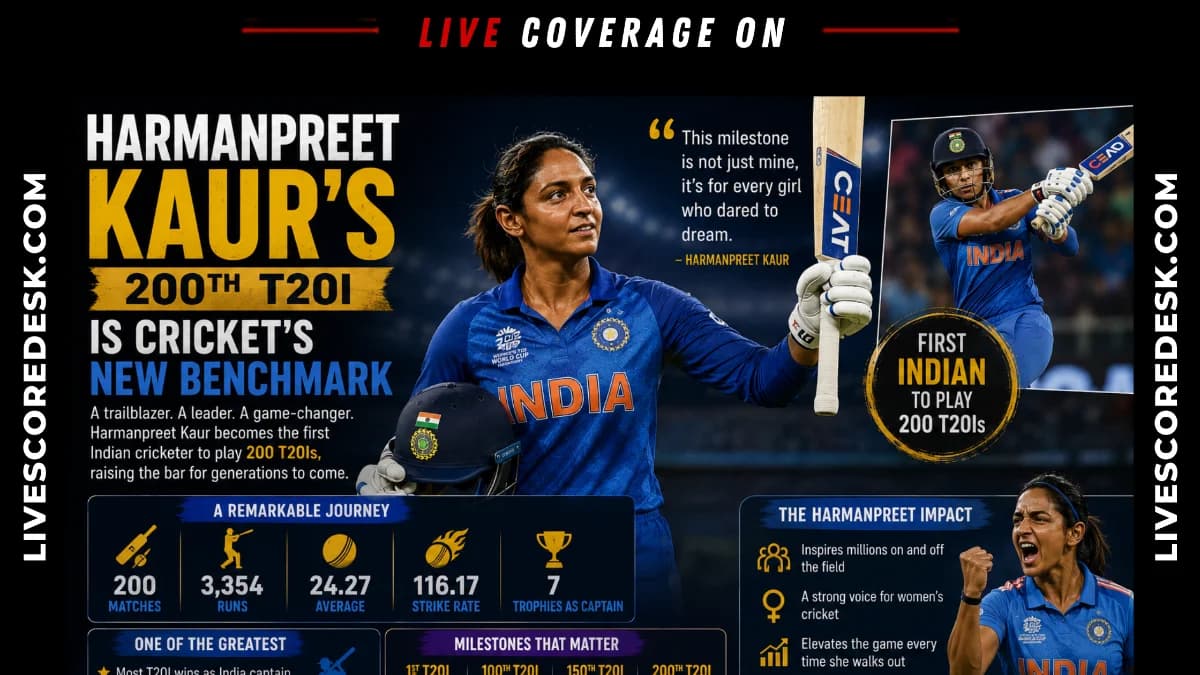
The most important number in women's cricket right now isn't a score. It's 200.
When Harmanpreet Kaur walks out against South Africa in Manchester, she is set to become the first cricketer — male or female — to play 200 T20 Internationals. Not Rohit Sharma. Not Ellyse Perry. Not any of the format's biggest global names. Harmanpreet will stand alone at the top of that list.
The milestone arrives during India's Women's T20 World Cup campaign, but the bigger story stretches far beyond one tournament. This is about longevity, relevance and influence. Twenty-over cricket has changed dramatically since Harmanpreet made her debut. Players have come and gone. Formats have evolved. Franchise leagues have reshaped careers. Through all of it, Harmanpreet has remained a central figure in Indian cricket.
Why Harmanpreet Kaur's 200 T20Is Matter More Than The Number
There is a temptation to treat appearance records as simple measures of endurance. That's too simplistic in this case.
Harmanpreet's career has survived multiple generations of Indian women's cricket. She played before packed stadiums became common. She played before the Women's Premier League existed. She played when professional opportunities were limited and when international calendars were far less crowded than they are today.
Now she leads a side that enters major tournaments with genuine title ambitions. India won their first Women's Cricket World Cup under her captaincy in 2025 and arrived at the 2026 Women's T20 World Cup among the favourites.
Here's the part nobody's saying out loud: reaching 200 T20Is isn't simply a reward for staying around. Plenty of talented cricketers last a long time. Very few remain indispensable for nearly two decades.
Harmanpreet has.
Her presence has spanned every edition of the Women's T20 World Cup, placing her among a select group of players who have experienced the tournament's complete evolution from a developing event into one of cricket's premier global competitions.
"Harmanpreet Kaur will play her 200th T20I on Sunday."
The Counter-Argument: Is The Record Just About Longevity?
Some would argue that appearance records can be misleading.
After all, playing 200 matches requires opportunity as much as excellence. Modern schedules are heavier than ever. International teams play more T20 cricket than previous generations did. The growth of the women's game has naturally created more chances to accumulate appearances.
That's a fair point.
But it ignores the harder reality. Players don't remain in international squads for 200 matches unless they continue contributing. Harmanpreet has done that as a batter, captain and senior figure inside a rapidly improving Indian setup. Her recent rise back into the ICC's top 10 T20I batting rankings before the World Cup suggested she remains an influential performer, not merely a ceremonial selection.
The evidence also shows that her impact extends beyond individual statistics. Under her leadership, India transformed from perennial contenders into a side capable of winning global titles. That shift matters when assessing her place in cricket history.
So yes, longevity is part of the achievement.
But relevance is the bigger story.
From Trailblazer To Standard-Bearer
Every era of Indian women's cricket has a defining figure.
For one generation it was Mithali Raj. For another it was Jhulan Goswami. Harmanpreet became the bridge between those pioneers and the modern era.
Her influence can be measured through milestones that once felt impossible. She became the first Indian woman to score a T20I century. She has been among India's leading performers across multiple World Cups. During the current tournament she surpassed Mithali Raj as India's highest run-scorer in Women's T20 World Cup history.
What separates Harmanpreet from many great players is timing.
The explosion of interest in women's cricket coincided with her peak years. As television audiences grew and professional leagues emerged, she became one of the sport's most recognisable faces. The growth of the game and the growth of her reputation happened together.
That isn't coincidence.
It's legacy.
What Comes Next After T20I Match No. 200?
The immediate focus is straightforward. India continue their Women's T20 World Cup campaign and Harmanpreet's attention will remain on results rather than records. South Africa are the next opponents and India are pursuing another major ICC title.
Yet records like this inevitably invite a bigger discussion.
Years from now, someone else may eventually reach 200 T20Is. Records are designed to be broken. The more difficult challenge will be matching the broader impact attached to Harmanpreet's milestone.
She didn't just accumulate matches. She helped expand what was possible for women's cricket in India. She played through the sport's transformation and remained relevant long enough to become its defining constant.
That's why the number matters.
Not because it's 200.
Because nobody had ever got there before.