
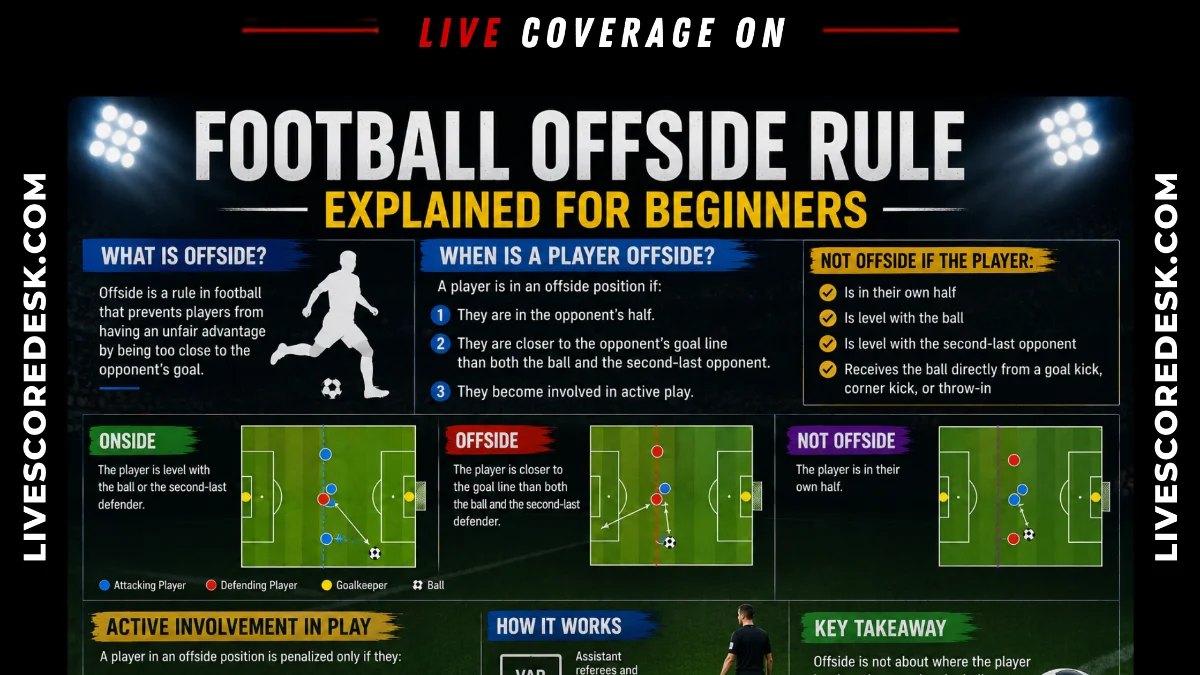
This is an educational reference guide explaining one of football's most misunderstood laws using official IFAB and FIFA Laws of the Game.
Football's offside rule influences thousands of decisions every season, yet it remains the law most commonly misunderstood by new fans. A goal can be celebrated by 50,000 supporters and then ruled out seconds later because of an offside call. That's why understanding the rule matters.
The offside rule exists for one reason: to prevent attackers from simply standing near the opponent's goal waiting for long passes. Without it, football would become far less tactical. Teams would bypass midfield battles and rely heavily on goal-hanging forwards.
For beginners, the confusion usually comes from one question: When exactly is a player offside? The answer isn't simply about being ahead of defenders. Timing, position and involvement in play all matter. Once those elements are understood, most offside decisions become much easier to follow.
What Counts as Offside?
A player is in an offside position if three conditions are met at the moment a teammate plays or touches the ball:
- 1. They are in the opponent's half.
- 2. They are nearer to the opponent's goal line than both the ball and the second-last defender.
- 3. They are involved in active play.
The phrase second-last defender often confuses new viewers. In most situations the goalkeeper is one of the last two defenders, which means fans often think of it as "behind the last outfield defender." However, the law refers to the second-last defender because the goalkeeper isn't always one of those two players.
Example
Imagine a striker standing behind every defender except the goalkeeper when a teammate passes the ball forward.
If the pass is played and the striker receives it from that position, the assistant referee will raise the flag. The striker was beyond the second-last defender when the ball was played.
Timing is everything.
A player can run beyond defenders after the pass is made. That is perfectly legal. Officials judge the position at the exact moment the ball leaves the passer's foot.
Common Misconception
Many fans believe a player is offside whenever they stand behind the defensive line.
That's incorrect.
A player can stand in an offside position all match long and never commit an offence if they do not become involved in play.
Being offside and committing an offside offence are different things.
Football Offside Rule Explained Through Active Play
The most important part of the law is involvement.
According to the International Football Association Board (IFAB), a player in an offside position is penalised only if they become involved in active play.
This can happen in three ways:
1. Interfering With Play
The player receives or touches the ball after being in an offside position.
Example: A forward receives a through ball while positioned beyond the defensive line when the pass was made.
2. Interfering With An Opponent
The player blocks a defender's movement, obstructs vision or challenges for the ball.
Example: A striker standing in front of the goalkeeper may be penalised even without touching the ball because they affect the goalkeeper's ability to make a save.
3. Gaining An Advantage
The player benefits from a rebound or deflection after originally being in an offside position.
Example: A shot hits the post and rebounds to an attacker who was already offside when the shot was taken.
That attacker can be penalised.
Football Offside Rule Explained: Situations Where Offside Cannot Be Given
Several restarts automatically cancel the possibility of an offside offence.
A player cannot be offside directly from:
- a. Goal kicks
- b. Throw-ins
- c. Corner kicks
This exception creates some interesting tactical opportunities.
For example, attackers often position themselves very high during long throw-ins because the offside law does not apply directly from that restart.
Many casual viewers incorrectly believe offside applies everywhere on the pitch. It doesn't.
Why VAR Has Changed Offside Decisions
Video Assistant Referee (VAR) has transformed how offside decisions are judged.
Before VAR, assistant referees had to make split-second decisions. Modern technology allows officials to review incidents frame by frame.
As a result, decisions now often involve margins measured in centimetres.
Example
An attacker's shoulder can legally score a goal.
If that shoulder is beyond the defensive line when the pass is played, VAR may rule the player offside even though their feet appear level.
This is why television broadcasts often display calibrated lines during reviews.
The technology checks the exact position of scoring body parts rather than simply where a player's boots are located.
Why Defenders Use The Offside Trap
The offside trap is one of football's oldest defensive tactics.
Instead of tracking runners deep into their own half, defenders move forward together just before a pass is played. The aim is simple: leave attackers beyond the defensive line.
Teams coached by Arrigo Sacchi's AC Milan in the late 1980s became famous for mastering this tactic. More recently, clubs managed by Jürgen Klopp and Mikel Arteta have frequently used aggressive defensive lines.
The risk is obvious.
If even one defender reacts late, the attacker remains onside and suddenly has a clear run at goal.
That balance between risk and reward is why the offside trap remains one of football's most fascinating tactical weapons.
Historical Comparison
Before VAR, many offside decisions relied entirely on assistant referees' judgement.
Today, elite competitions use semi-automated offside technology at major FIFA tournaments. This significantly reduces decision times and improves accuracy.
The law itself has not changed dramatically.
The way it is enforced has.
Frequently Asked Questions About The Offside Rule
Is a player offside if they are level with the defender?
No.
Being level with the second-last defender is considered onside.
Can a goalkeeper play someone onside?
Yes.
The law refers to the second-last defender, not specifically the goalkeeper.
Can you be offside in your own half?
No.
A player must be in the opponent's half to be in an offside position.
Why are some goals checked for so long?
VAR reviews the exact moment the ball was played and the precise positions of attackers and defenders. Small margins can require detailed analysis.
Can a player be offside without touching the ball?
Yes.
If they interfere with an opponent, block vision or affect play, they can still be penalised.
Final Takeaway
The football offside rule is far less complicated than many fans assume. The key principle is timing. Officials judge a player's position at the moment the ball is played, not when it is received. From there, involvement determines whether an offence has occurred.
Once you understand the concepts of the second-last defender, active play and restart exceptions, most controversial offside decisions become much easier to interpret.
The next time a goal is ruled out after a lengthy VAR review, you'll know exactly what officials are checking. And if you're following matches on LiveScoreDesk, understanding the offside rule will make every attacking move far more interesting to watch.