
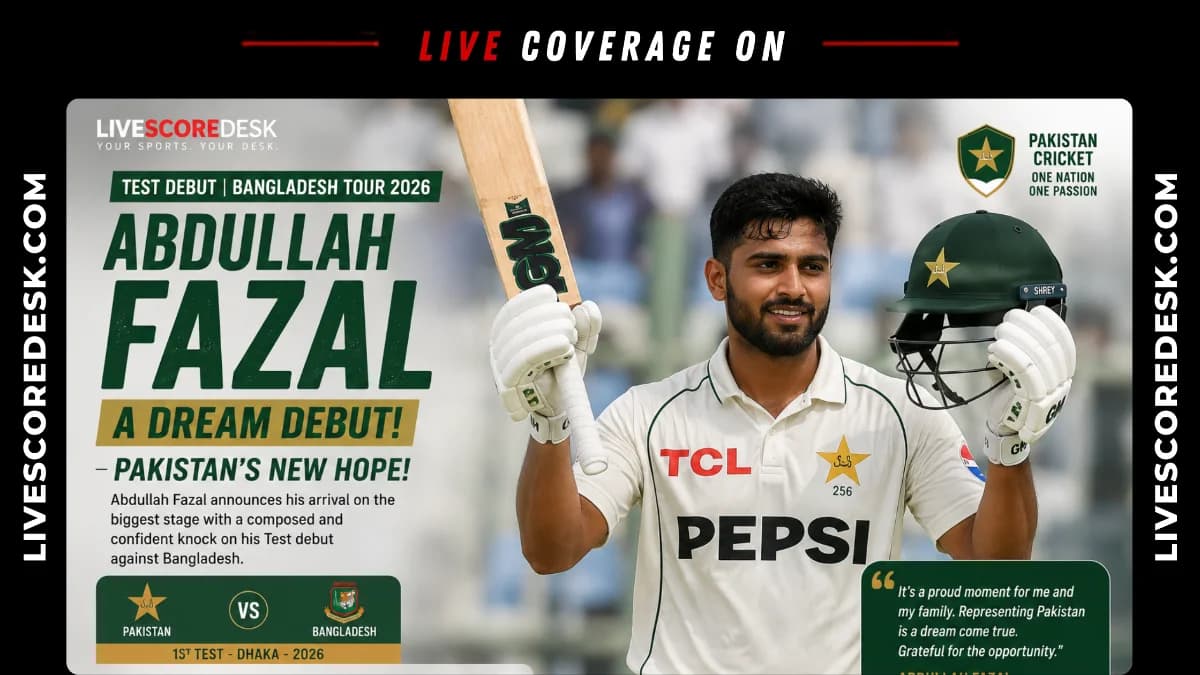
Ever-improving Abdullah Fazal looks built for Pakistan's Test future
By Kartik Sharma | Data Analyst & Reporter (KS)
2 years. That's roughly how long it has taken Abdullah Fazal to go from an overlooked domestic batter to one of Pakistan's most promising Test openers. His rise has been unusually fast, but the bigger question is whether the 22-year-old can turn an impressive start into a long international career.
Pakistan believe the signs are encouraging. So does Karachi Blues coach Iqbal Imam, who identified Fazal's potential long before the left-hander reached the national side. Recent performances in Bangladesh and the Caribbean have only strengthened the argument that Pakistan may have found a dependable red-ball opener for the next cycle of the ICC World Test Championship.
Why Abdullah Fazal's development stands out
Fazal's story is unusual because it didn't begin with immediate success.
He first appeared in senior domestic cricket during the 2023 Hanif Mohammad Trophy, where he managed only 27 runs in four innings before being dropped. Those numbers suggested little. His technique, however, suggested something different.
Iqbal Imam, who coached him at Karachi Blues, looked beyond the scorebook.
"He was reaching for balls away from his body. But I saw power in his shots, and his basics were quite impressive."
That early assessment proved important. Rather than judging Fazal by a poor tournament, Imam focused on his balance, bat swing and ball contact. Those technical foundations became the basis of rapid improvement over the following two domestic seasons.
Many successful Pakistan batters have required several years to establish themselves in first-class cricket. Fazal compressed that learning curve into less than two seasons.
Domestic numbers backed the technical improvements
The breakthrough came during the 2024-25 domestic season.
With Saim Ayub unavailable because of international commitments, Fazal earned an opportunity at the top of Karachi Blues' batting order and made it count.
His season included:
Those performances demonstrated versatility rather than simply consistency.
The red-ball centuries highlighted patience against experienced fast bowlers. The T20 numbers showed he could change tempo without compromising his technique. That combination increasingly appeals to modern Test selectors, particularly for top-order batters expected to score across formats.
"He's a naturally attacking player whose defence is very solid."
"He's a naturally attacking player whose defence is very solid."
Opportunity arrived earlier than expected.
Pakistan travelled to Bangladesh with Fazal outside the likely starting XI, but an injury to Babar Azam opened the door. Instead of looking overawed, Fazal finished as Pakistan's leading run-scorer in the Test.
His debut produced scores of 60 and 66, both compiled on demanding surfaces against an experienced Bangladesh attack.
More significant than the runs themselves was how they came.
Fazal consistently got close to the pitch of the ball, used his feet confidently against spin and allowed seamers to come underneath his eyes before committing to strokes. Those are technical traits often associated with experienced Test openers rather than debutants.
Pakistan have struggled to settle their opening combination since the retirement of several established names. Fazal's first Test suggested the selectors may finally have another genuine option.
Relevant statistics
| Category | Figure |
|---|---|
| Hanif Mohammad Trophy 2023 | 27 runs in 4 innings |
| National T20 2024 | 231 runs in 4 matches |
| Test debut vs Bangladesh | 60 & 66 |
| Tour match vs West Indies Select XI | 50* & 48* |
England and West Indies will provide the real examination
Imam believes Fazal's technique should travel well, although different conditions will ask different questions.
In the West Indies, uneven bounce demands disciplined shot selection.
England presents another challenge altogether.
The Dukes ball encourages movement outside off stump, tempting opening batters into uncertain drives. Imam's advice has been straightforward: avoid pushing at the ball and commit fully whenever attacking.
"In England, players who nudge and push at the ball struggle. I'm confident that is not a mistake he will make."
That confidence is built on mechanics rather than optimism.
Imam also highlighted an interesting physical characteristic. Fazal throws right-handed while batting left-handed, making him particularly top-hand dominant. Several accomplished left-handers—including Garry Sobers, Brian Lara, Chris Gayle and Saim Ayub—share similar traits, although Imam stressed he was illustrating a technical advantage rather than comparing careers.
Recent evidence supports the coach's optimism.
Before Pakistan's Test series in the Caribbean, Fazal scored 50 not out and 48 not out against a West Indies Select XI. The contrast between the innings was notable: the first required patience across 97 deliveries, while the second came at almost a run a ball with three sixes.
That flexibility may become his greatest strength.
Pakistan's batting has often relied heavily on experienced names to anchor innings overseas. If Fazal continues adapting across conditions while maintaining the disciplined shot selection that marked his debut, he could become a long-term fixture at the top of the order.
His rise has already defied expectations. The next challenge is sustaining it against higher-quality attacks in the West Indies and England. If he succeeds there, another number will matter most: how many overseas Test hundreds can Abdullah Fazal add before the current World Test Championship cycle ends?