
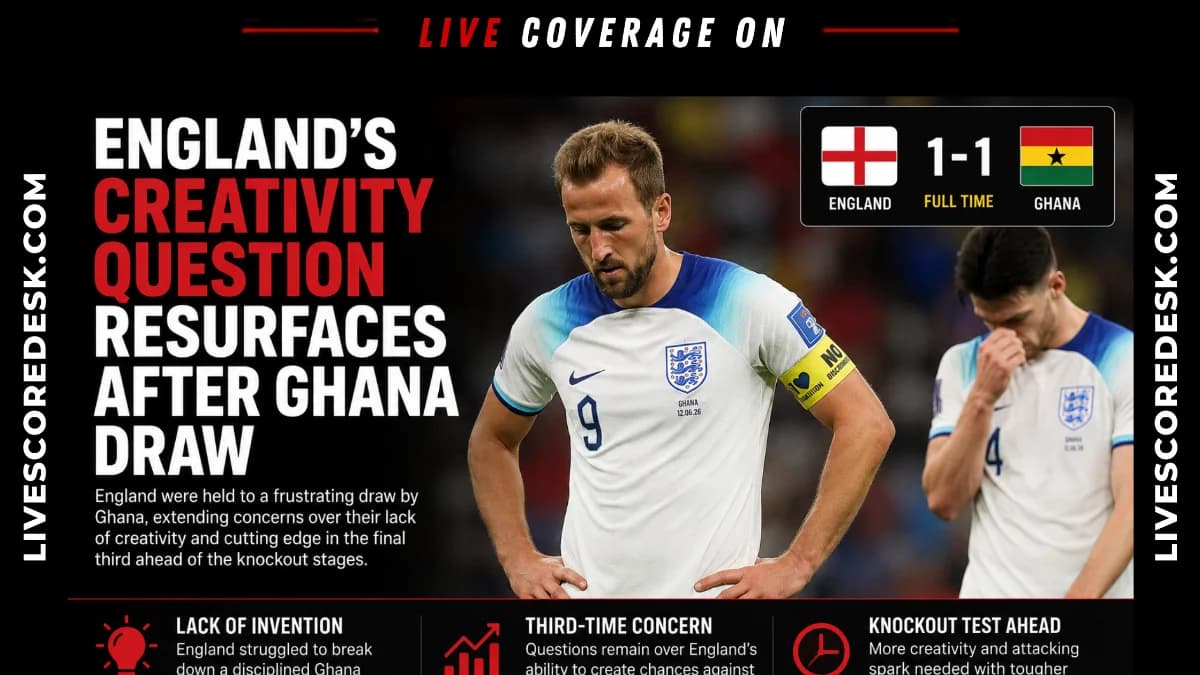
England's Creativity Problem Returns After Ghana Stalemate
The rain hangs over Boston Stadium, the crowd grows restless and every sideways pass seems to carry a little more frustration. England have the ball. Lots of it. Yet the feeling inside the ground is that something is missing. That's the debate Thomas Tuchel now faces after England's goalless draw with Ghana: are the Three Lions genuinely progressing, or do familiar attacking issues still linger beneath the surface?
The trigger for that discussion was Tuesday's 0-0 World Cup Group L draw with Ghana. England arrived in Massachusetts buoyed by a thrilling 4-2 victory over Croatia, only to be brought back down to earth by a disciplined Ghana side coached by Carlos Queiroz. England dominated possession and territory but couldn't find a breakthrough, leaving supporters with a sense of déjà vu.
Why England's Attack Has Become The Main Talking Point
On paper, England controlled the contest. In reality, control rarely translated into danger.
The numbers tell a revealing story. England enjoyed nearly 79 per cent possession and registered 18 shots, yet much of their play unfolded in front of Ghana's compact defensive structure. The Black Stars were content to concede territory and challenge England to find solutions. Too often, those solutions never arrived.
Harry Kane's late miss summed up the evening. After Nico O'Reilly's header struck the crossbar in the closing stages, the England captain blazed the rebound over. It was the kind of opportunity Kane usually converts without hesitation. England's best chance had come and gone.
Questions quickly followed. Why did England struggle to move Ghana's defensive block? Why did a side packed with creative talent produce so few clear-cut openings?
Marc Guehi and Declan Rice emerged among England's brighter performers. Guehi completed a World Cup-leading 126 passes and recorded 143 touches, while Rice created six chances and attempted three shots. Yet dominance from deeper areas wasn't matched by invention in the final third.
"England had 78 per cent of possession and 18 shots but created precious little of genuine quality."
A worrying pattern, perhaps.
Tuchel's Defence And The Reasons For Optimism
The counter-argument is straightforward: England weren't poor enough to justify panic.
Tuchel's side remain unbeaten in Group L and still control their qualification destiny. Ghana were organised, disciplined and clearly arrived with a plan to frustrate. Sometimes tournament football looks exactly like this. Not every match becomes an open spectacle.
England's manager responded with attacking substitutions, introducing Bukayo Saka, Nico O'Reilly and Marcus Rashford as he searched for a breakthrough. Saka immediately added urgency, while O'Reilly came within inches of winning the match. Those changes at least suggested England possess alternative options when matches become tactical battles.
Then there's the wider context.
England have now drawn their second group-stage match in four consecutive major tournaments. It happened against Scotland at Euro 2020, the United States at the 2022 World Cup, Denmark at Euro 2024 and now Ghana in 2026. Yet previous tournaments show these draws don't automatically derail campaigns.
Jude Bellingham acknowledged that history after the match, expressing frustration at England's recurring "second-game" problem while insisting the squad remains in a strong position heading into the final group fixture.
Panama Now Becomes The Real Test
England's next assignment against Panama suddenly carries extra intrigue.
A victory should secure progression and could still see Tuchel's side finish top of Group L. Yet the bigger issue isn't qualification. It's proof. Can England demonstrate they have the creativity required to break down stubborn opponents when knockout football inevitably becomes cagey?
That's what supporters will be watching for now. The Croatia win showcased England's attacking ceiling. The Ghana draw exposed potential limitations. Somewhere between those two performances lies the truth about this squad's World Cup prospects.