
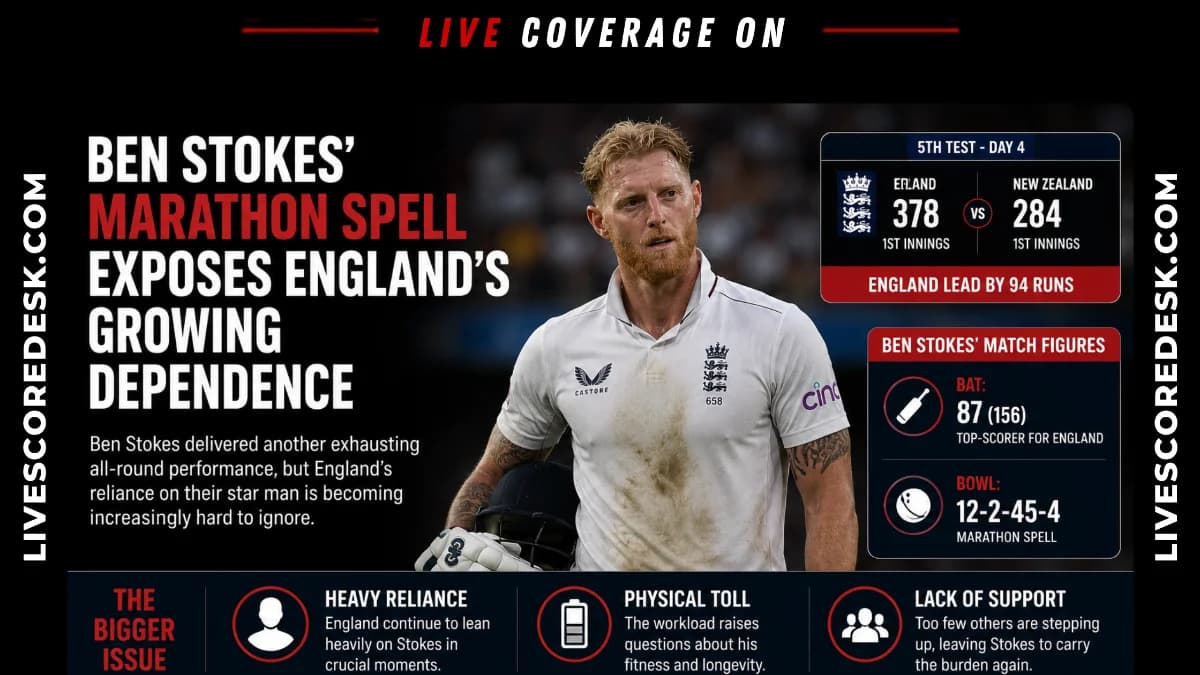
Ben Stokes' Relentless Spell Shows Why England Still Lean on One Man
By Kartik Sharma | Data Analyst & Reporter
250 Test wickets and more than 7,000 Test runs. Only two men in cricket history have reached that double: Ben Stokes and Jacques Kallis. Yet the numbers behind Stokes' latest performance at Trent Bridge tell a different story. England's captain isn't chasing records anymore. He's carrying a team that still turns to him whenever the pressure peaks.
Day two of the third Test against New Zealand reignited that conversation. England had watched Tom Latham and Devon Conway build a commanding 317-run opening stand before Stokes dragged his side back into the contest with an eight-over burst from the Stuart Broad End. His figures of 4 for 70 helped trigger a collapse from 317 without loss to 438 all out before England replied with 223 for 2 by stumps. The spell became the defining image of the day, but the wider debate runs deeper. How long can England continue asking their captain to rescue matches with body and ball?
Why Ben Stokes Remains England's Ultimate Problem Solver
England's bowling attack is evolving. Injuries, retirements and inexperience have forced fresh faces into the side, leaving Stokes as the dependable constant whenever the game demands control.
Friday's spell captured that responsibility perfectly.
Bowling in temperatures of around 35°C—the second-hottest recorded day in English men's Test cricket—Stokes delivered eight consecutive overs at an average speed of 82.9 mph. During that spell he dismissed Tom Latham, Daryl Mitchell and Will O'Rourke while conceding only 13 runs, transforming New Zealand's innings after they had appeared set for an imposing total.
His performance wasn't built on express pace alone. Persistent fourth-stump lines, disciplined lengths and relentless intensity forced mistakes from batters who had looked settled for much of the morning.
Comparative Breakdown
- 1. Opening partnership: 317 runs (Latham & Conway)
- 2. Collapse after Stokes' intervention: 121 runs for the final 10 wickets
- 3. Stokes' decisive morning spell: 8 overs, 13 runs, 3 wickets
- 4. England at stumps: 223 for 2 after New Zealand were dismissed for 438
That sequence explains why England still rely so heavily on one player.
"I don't know how Kallis did it for so long."
The Other Side of the Debate: Leadership Demands Sacrifice
England's management have never hidden their admiration for Stokes' willingness to shoulder responsibility.
According to ESPNcricinfo's reporting, team-mates often describe him entering an almost trance-like state during extended spells. Former captain Joe Root has struggled to persuade him to stop bowling once he finds his rhythm, while head coach Brendon McCullum has previously relied on bowling coach Tim Southee to intervene during similarly demanding spells.
That determination remains central to England's culture.
Only days earlier, Stokes had apologised to team-mates after breaking his self-imposed curfew following the Lord's Test. His response came not through words but through action, first with a lengthy spell late on day one and then another punishing burst on Friday morning.
England value that accountability. Few captains ask more of themselves than of everyone else.
Yet it also raises uncomfortable questions.
Stokes has suffered two hamstring tears and an adductor injury during the past two years. Every extended spell increases both England's chances of success and the risk of losing their captain for another lengthy period.
History offers another perspective. Jacques Kallis accumulated his remarkable all-round numbers while making the workload appear almost effortless. Stokes has achieved similar statistical milestones through a very different route. His cricket is visibly physical, emotionally draining and increasingly costly.
Since the start of England's 2024 home summer—after resolving his long-standing knee issues—Stokes has bowled 14 spells of eight overs or longer, more than any other bowler in Test cricket during that period. New Zealand's Matt Henry is next with ten.
Those figures illustrate England's dependence more clearly than any headline.
Can England Reduce the Burden on Ben Stokes?
The immediate concern isn't whether Stokes can still produce decisive spells. Friday proved he can.
Instead, England must determine whether they can build an attack that doesn't require those efforts so frequently.
The captain has already adjusted his batting responsibilities, dropping himself to No. 7 ahead of this series to reduce his mental workload and allow Jamie Smith greater opportunity higher up the order. That tactical shift acknowledged an uncomfortable truth: trying to remain England's premier batter, strike bowler and captain simultaneously has become unsustainable.
His bowling has compensated for declining returns with the bat, but the balance is shifting. England need greater support from the rest of the attack if they are to protect both their captain and their long-term ambitions.
Trent Bridge offered another reminder of Stokes' unique value. Few cricketers combine leadership, endurance and competitive instinct quite like him. Yet it also reinforced the uncomfortable reality that England still reach for the same solution whenever problems arise.