
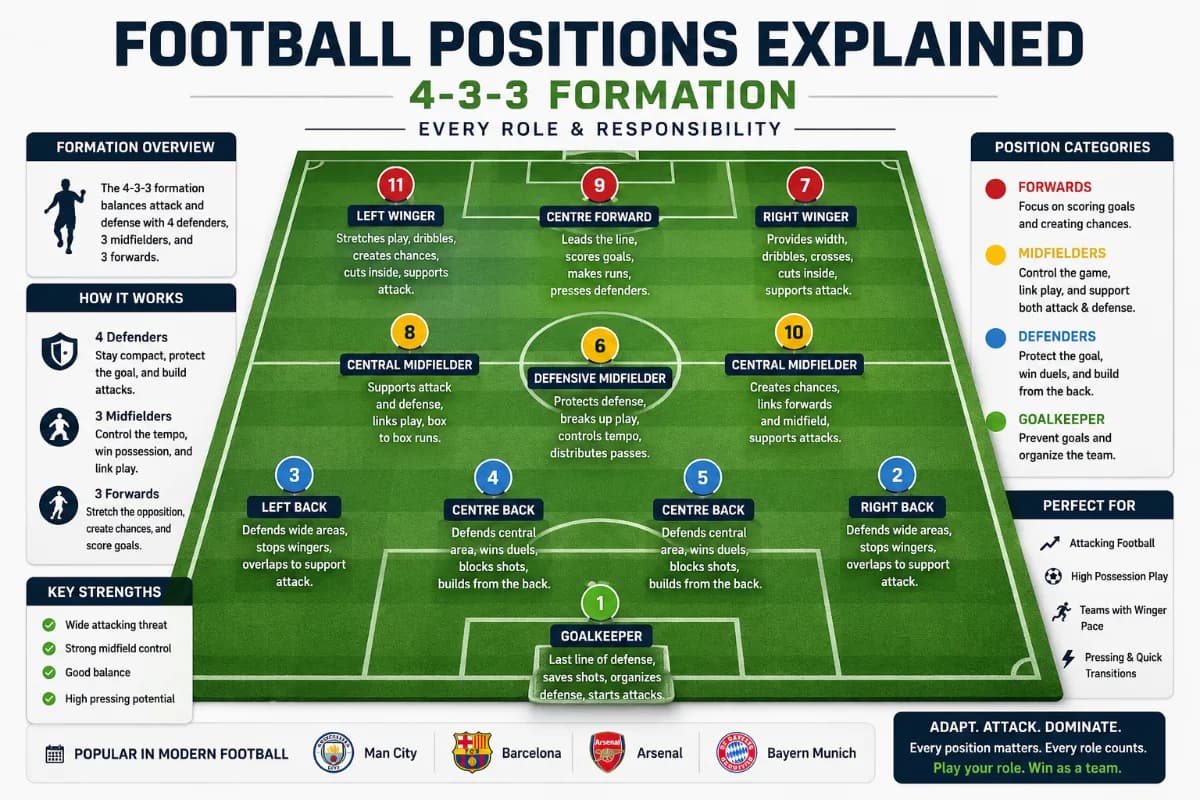
Football Positions Explained: Every Role & Responsibility
Every successful football team is built on players understanding their roles before they showcase their talent. That's the biggest misconception among new fans. Goals win highlights, but positions win matches.
Football positions explained remains one of the most searched football topics because the game has become more tactical than ever. Modern football isn't simply about defenders defending and strikers scoring. Full-backs now become midfielders, goalkeepers launch attacks, and centre-forwards often create more chances than they finish. Whether you're watching the Premier League, UEFA Champions League or FIFA World Cup, understanding every position transforms the way you see the game.
At its simplest, a football team consists of 11 players: one goalkeeper, defenders, midfielders and forwards. Their starting locations may change depending on formations such as 4-3-3, 4-2-3-1 or 3-5-2, but every position carries core responsibilities that remain consistent. Here's the part nobody's saying out loud: formations don't win football matches—players executing their roles do.
Football Positions Explained: The Goalkeeper's Role
The goalkeeper (GK) is the team's final line of defence and the only player permitted to handle the ball inside their own penalty area under the Laws of the Game.
Stopping shots remains the primary duty, but the modern goalkeeper is expected to do much more. Elite keepers organise the defensive line, claim crosses, distribute possession accurately and often begin attacking moves with precise passes.
Imagine an opposition striker racing onto a through ball. Rather than waiting on the goal line, today's goalkeeper frequently rushes outside the six-yard box to clear the danger before the striker reaches it. This proactive approach is commonly known as the "sweeper-keeper" role.
A common misconception is that goalkeepers only touch the ball when defending. In reality, many of the world's best teams deliberately build attacks through their goalkeeper, treating them almost like an extra outfield player during possession.
Football Positions Explained: Every Defensive Position
Centre-Back (CB)
Centre-backs operate in the middle of defence.
Their responsibilities include:
- - Marking opposition forwards
- - Winning aerial duels
- - Blocking shots
- - Making tackles
- - Intercepting passes
- - Building attacks from deep
Modern centre-backs are expected to stay calm under pressure. Instead of simply clearing the ball, many now break opposition pressing lines with accurate forward passes.
For example, if an opponent presses high, a composed centre-back may bypass midfield entirely with a long diagonal pass to a winger.
Full-Back (RB & LB)
Right-backs and left-backs defend wide areas while supporting attacks.
Their main duties include:
- - Stopping opposing wingers
- - Preventing crosses
- - Making overlapping runs
- - Providing width
- - Supporting possession
When a winger cuts inside towards goal, the overlapping full-back often becomes the widest attacking player.
Wing-Back
Wing-backs are commonly used in formations with three centre-backs.
Unlike traditional full-backs, wing-backs spend almost as much time attacking as defending.
They are responsible for:
- - Covering the entire flank
- - Delivering crosses
- - Recovering defensively
- - Stretching opposition defences
- - Supporting midfield
Because they constantly move between penalty areas, wing-backs require exceptional stamina.
Football Positions Explained: Every Midfield Role
Defensive Midfielder (CDM)
Often called the holding midfielder, this player sits just ahead of the defenders.
Responsibilities include:
- - Breaking up attacks
- - Shielding the defence
- - Winning loose balls
- - Retaining possession
- - Controlling the game's tempo
For example, when possession is lost, the defensive midfielder often becomes the first player to stop a counter-attack before defenders are exposed.
These players rarely receive headlines, but coaches frequently describe them as the team's tactical foundation.
Central Midfielder (CM)
Central midfielders perform both attacking and defensive responsibilities.
Their job involves:
- - Passing between defensive and attacking units
- - Carrying possession forward
- - Supporting pressing
- - Recovering defensively
- - Maintaining balance
A true box-to-box midfielder might block a shot inside their own penalty area before arriving in the opposition box seconds later.
Attacking Midfielder (CAM)
The attacking midfielder operates behind the striker.
Responsibilities include:
- - Creating scoring opportunities
- - Playing through balls
- - Shooting from distance
- - Finding space between defensive lines
- - Linking midfield with attack
If defenders concentrate on the centre-forward, the attacking midfielder often becomes the most dangerous creative player on the pitch.
Football Positions Explained: Every Forward's Responsibility
Centre-Forward / Striker (CF/ST)
The striker's primary role is finishing chances.
Responsibilities include:
- - Scoring goals
- - Holding up possession
- - Pressing defenders
- - Making attacking runs
- - Creating space for teammates
- Not every striker plays the same way.
A target forward uses physical strength and aerial ability to bring teammates into play, while a poacher relies almost entirely on intelligent movement inside the penalty area.
Wingers (LW & RW)
Wide forwards attack from both flanks.
Their duties include:
- - Dribbling past defenders
- - Delivering crosses
- - Cutting inside to shoot
- - Creating overloads
- - Tracking opposition full-backs
Traditional wingers stayed close to the touchline throughout matches. Modern inverted wingers frequently move inside onto their stronger foot, allowing overlapping full-backs to provide width.
Second Striker
A second striker plays just behind the main centre-forward.
They combine creativity with finishing by:
- - Linking midfield and attack
- - Exploiting space
- - Creating chances
- - Scoring goals
- - Pressing defenders
Because they operate between midfield and defence, opponents often struggle to decide who should mark them.
Football Positions Explained: How Formations Affect Every Role
One reason football positions confuse new supporters is that formations constantly change.
A left-back in one system may attack relentlessly, while another in a different formation barely crosses the halfway line.
4-3-3
This formation usually features:
- - One holding midfielder
- - Two attacking full-backs
- - Wide forwards stretching the pitch
- - A lone striker leading the attack
4-2-3-1
Common responsibilities include:
- - Two defensive midfielders providing balance
- - One attacking midfielder creating chances
- - Wide attackers supporting a central striker
3-5-2
This system relies heavily on:
- - Three centre-backs
- - Wing-backs providing width
- - Two forwards combining centrally
The numbers describe where players begin, not necessarily where they finish during an attack.
Football Positions Explained: Traditional Shirt Numbers
Football Positions Explained: Frequently Asked Questions
One question appears more than almost any other: which position is the hardest to play?
There's no universal answer because every role demands different skills.
Goalkeepers face enormous pressure since mistakes often result directly in goals. Central midfielders must constantly read the game while contributing in possession and defence. Wing-backs cover the greatest physical distance, while strikers often have only one or two clear opportunities to decide an entire match.
Another common question concerns versatility. Can players switch positions?
Absolutely. Modern football increasingly rewards adaptable players. Full-backs often move into midfield during possession, central defenders can step forward as playmakers, and forwards regularly rotate positions to confuse opposition defences. Tactical flexibility has become one of the defining characteristics of elite football.
Football positions explained isn't just about learning names on a team sheet—it's about understanding how every player contributes to a collective system. The best teams succeed because each individual understands when to defend, when to attack and when to adapt.
Next time you watch a match, don't simply follow the ball. Watch how defenders organise space, midfielders dictate tempo and attackers manipulate defensive lines with intelligent movement. That's where football's real story unfolds.
For more tactical guides, live scores and match analysis, explore LiveScoreDesk's football coverage alongside our formation explainers and competition pages.