
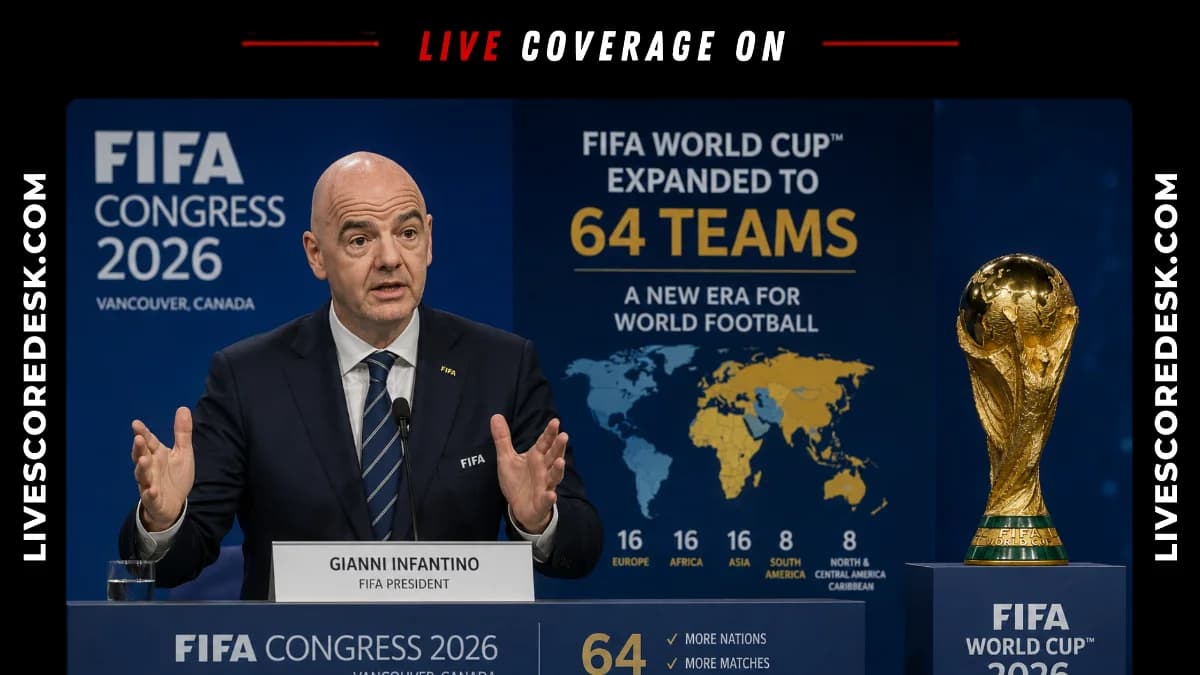
The 64-team FIFA World Cup risks turning football's greatest tournament into a competition that is simply too big.
The 64-team FIFA World Cup is back in football's conversation after FIFA president Gianni Infantino confirmed the governing body would examine a proposal to expand the men's World Cup beyond the already-approved 48-team format. No decision has been taken, but the fact that the idea is being discussed at FIFA's highest level has reignited one of the sport's most divisive debates.
The proposal emerged during a FIFA Council meeting ahead of the 2026 FIFA Congress, where a delegate suggested increasing the tournament to 64 teams for the 2030 World Cup, which will be co-hosted primarily by Spain, Portugal and Morocco while also staging commemorative opening matches in Argentina, Uruguay and Paraguay. FIFA later confirmed that, in line with its duty to consider proposals from member associations, the idea would be analysed. That's enough to shift the conversation from fantasy to possibility
The 64-Team FIFA World Cup Would Rewrite Football's Biggest Event
A World Cup featuring 64 nations would represent the most dramatic change in the tournament's history. FIFA has already expanded the competition from 32 to 48 teams for the 2026 edition, increasing the number of participating countries by 50 per cent before a single ball has even been kicked under the new format.
Here's the part nobody's saying out loud: football hasn't yet seen whether 48 teams improve or dilute the World Cup experience. Expanding again before evaluating that experiment would be a gamble.
Supporters argue the benefits are obvious. More countries would qualify, more confederations would receive additional places, and millions more supporters would see their national teams on football's biggest stage. Emerging football nations across Africa, Asia, Oceania and the Caribbean could gain valuable experience while increasing the tournament's global reach.
"FIFA has a duty to analyse any proposal from one of its Council members."
Inclusion Versus Sporting Quality
The strongest case for expansion is rooted in inclusion. FIFA has long argued that football is a global game and that its flagship tournament should reflect that reality. The move to 48 teams was justified on similar grounds, giving more nations access to the World Cup while creating additional commercial opportunities and broadcasting markets.
Yet the counter-argument is equally compelling.
A larger tournament means more matches, a longer calendar and greater demands on players who already face congested domestic and international schedules. Clubs, leagues and player unions have repeatedly voiced concerns about fixture congestion, recovery time and injury risk as the football calendar continues to expand.
There's also the competitive question. One reason the World Cup has retained its prestige is the difficulty of qualifying. Increasing the field to 64 teams would inevitably lower that barrier for many confederations. While fresh stories and new participants are welcome, critics fear the tournament could include significantly more mismatched contests during the group stage, reducing the overall quality of football.
The debate therefore isn't simply about numbers. It's about whether the World Cup should prioritise global representation above competitive exclusivity—or whether the balance that has defined the tournament for decades is already close to its limit.
What FIFA Says — And Why That Doesn't End The Debate
Infantino and FIFA have been careful not to present the proposal as a foregone conclusion. The governing body's position is procedural rather than promotional: any formal proposal submitted by a FIFA Council member deserves consideration. That approach is consistent with FIFA's governance framework, but it has inevitably fuelled speculation about whether another expansion is already gathering momentum.
Supporters of the idea point to football's growing global footprint. The men's World Cup has expanded repeatedly since its inaugural 13-team tournament in 1930, reaching 24 teams in 1982, 32 teams in 1998 and 48 teams from 2026 onwards. Each increase was initially met with scepticism before becoming part of the competition's history.
Still, history doesn't automatically justify another leap.
The strongest argument against a 64-team FIFA World Cup isn't nostalgia; it's timing. Football has yet to see how the 48-team competition performs in practice. The expanded format in the United States, Canada and Mexico will introduce 12 groups of four teams and a 104-match tournament—already the largest in FIFA World Cup history. Until organisers, broadcasters, players and supporters experience that event, there's limited evidence to judge whether another expansion would genuinely improve the competition.
STATS
| Category | Fact |
|---|---|
| Current FIFA World Cup format | 48 teams from 2026 |
| Previous format | 32 teams (1998–2022) |
| Proposed future format | 64 teams (under discussion only) |
| 2026 tournament hosts | United States, Canada and Mexico |
What Comes Next For FIFA's Expansion Debate
Any move to a 64-team World Cup would require formal approval through FIFA's decision-making processes, and there is currently no confirmed timeline for such a vote. For now, the governing body remains focused on delivering the first 48-team World Cup in 2026, an event that will serve as the clearest test yet of whether a significantly larger tournament can maintain the competitive intensity and global appeal that have defined the competition for generations.
My verdict is straightforward. Football should resist another expansion until the 48-team model has been properly judged. If the 2026 World Cup proves that a larger tournament enhances quality without sacrificing prestige, then a fresh discussion will be justified. Until then, turning the FIFA World Cup into a 64-team competition would be a solution searching for a problem rather than one solving it.